Site Meter

Wednesday, January 03, 2007

His Rattle Will Make Amends


The calculation of time, I can’t help noticing, is based on the position of the earth relative to the sun using noon as a marker, when the sun is highest in the sky. The length of a second corresponds to the length of time required for 9,192,631,770 cycles of the caesium atom at zero magnetic field. However, civil time is occasionally adjusted by increments of one second to ensure that the difference between a uniform time scale defined by atomic clocks does not differ from the earth’s rotational time by more than 0.9 seconds. The second so added is termed a ‘leap second’. After UTC (co-ordinated universal time) 23:59:59, an additional second is counted at 23:59:60 before the clock jumps to 00:00:00 of the next day. When 3 to 13 September 1752 were eliminated by act of parliament to bring Britain into line with the Gregorian calendar, there were protests in the streets. How many leap seconds have come and gone since then and what have we done with them? I feel I ought to account for myself.

Next: taking the bottom A on a piano tune twelve perfect fifths to the top, or tune seven perfect octaves. The results are not quite the same: a tiny difference is detectible between the two, known as the ‘Pythagoras comma’. Piano-tuners cover this up by dispersing it within the interval of the fifth, in the compromise system known as ‘tempered [for ‘tampered’] tuning’. Without it the octave system, whereby A in one octave corresponds to A in all the others, would be impossible. Scarlatti knew all about this, which is one reason why he sticks so rigidly to certain keys (not much Scarlatti in G flat). Yet careful comparison of apparently identical intervals on the piano, e.g. B – F sharp, B flat – F, reveals the giveaway traces, the fingerprints of the Pythagoras comma. Because they’re not the same, are they? No. On the harpsichord D sharp and E flat were separate keys. Not to speak of the proper A of international concert pitch, with 440 double vibrations per second, and the wandering star of its baroque equivalents. Discrepancies, discrepancies.

We live not only in sounds but in the notations of sounds, we live not only in time but in the notation of time. Yet both would appear to be wrong, very rightly wrong. Do something about this. Do it right now. I bring a tuning fork down hard on the table just as the clock radio flicks to midnight. The interval between us I hereby declare perfect.

Céline


Beckett on Céline's Mort à Crédit: 'What is essential is not to know whether we are wrong or right – that is quite unimportant. What is important is to discourage the world from concerning itself with us. All the rest is vice.'

Tuesday, January 02, 2007

T.S. Eliot Prize


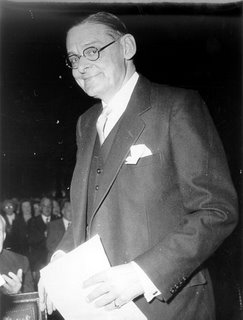
It was T.S. Eliot who said 'There is no competition among poets', so it's always a pity when the prize named after him rolls round again, as it's about to do. Hereunder, prompted by its impending visitation, some old thoughts on contemporary British poetry, as represented by The New British Poetry, Charles Simic and Don Paterson's Britpo-explained-to-the-Yanks anthology for Graywolf.

It’s unfortunate the way anthologies get reviewed for their introductions rather than their contents, but since the contents of this US-published book will be familiar to anyone living in Britain or Ireland remotely interested in the subject (I counted one writer, John Glenday, whose work was new to me), that leaves us Don Paterson’s introduction to talk about. It’s a bizarre performance, confirming all the stereotypical faults of British poetry and adding some extra just for you. Faults such as: slavish deference to an imagined common reader, neurotic fear of innovation or anything too difficult, and a wounded, wary defensiveness in the face of any criticism. For reasons I fail to grasp Paterson devotes much of the intro to a group of poets not in his book and whom he doesn’t even bother naming. These are the evil Postmoderns, as against the Mainstream poets he has included, and yes, he does call them that. Is there a grimmer, more dismal label to pin on a writer than ‘mainstream’? I’d take a knee in the groin over a pat on the head for being any such thing, any day, but Paterson has his reasons. These are writers, he wants to reassure us, that steer a middle course between sestinas-R-us New Formalism and splatter-gun L=A=N=G=U=A=G=E poetry. These mainstreamers are all-round regular kinda guys, and unlike their deviant counterparts still use language to communicate. They’re the (not so) young generation and they’ve got something to say, unlike those postmodern dingbats holding forth to their ‘academic’ audience. Which is presumably why back in the real world roughly half Paterson’s mainstreamers have taught creative writing in universities.

Paterson’s double-think on this subject is very repetitive, be warned. His pantomime villains are held up as laughable yet ubiquitously evil, insignificant yet powerful enough to have ruined playtime for all the other kiddies. The rightness of the mainstream cause is unassailable, yet must be thumpingly reiterated in the spirit of Hopkins’ ‘man bouncing up from the table’ (Robert Browning, in fact) ‘with his mouth full of bread and cheese and saying that he meant to stand no blasted nonsense.’ The literary history behind all this couldn’t be more conformist or unoriginal. Since the days of high modernism we’ve learned to live with T.S. Eliot, just about, but don’t go trying any Pound on us. The 1940s too tried to lead us astray, but then along came the 1950s and everything turned out just fine. Our current poetic Happy Meal comes with a heady swill of PR cant: the late Michael Donaghy’s poems are ‘perhaps’ (exquisite scruple) ‘built to last in a way few other poets in the language can currently rival’; Andrew Motion has ‘confounded the doubters by emerging as the most energetic and forceful advocate for the art [the laureateship] has seen’; John Burnside’s ‘radiant meditations have been perhaps’ (again!) ‘the most quietly and pervasively influential voice to have emerged in British poetry in the last twenty years’; and Jo Shapcott is ‘one of the most original voices in the language.’

There is talk of mainstream poets being brave enough to risk sounding mundane: ‘original expression… always runs the risk of cliché; the clear articulation of deep emotion always runs the risk of sentimentality; and taking the chance of being largely understood always runs the risk of being found to be talking a pile of garbage.’ Paterson is evidently happy to lead by example. And so on. To confront Paterson’s big question, though, every critic should have a line on the mainstream versus avant garde debate, and mine is this. There certainly is such a thing as a soft mainstream orthodoxy that deserves nothing but scorn, but at the same time it is very difficult for writers to self-identify as innovative or avant garde without falling headlong into sanctimony of the worst kind. For that reason alone it’s probably best to avoid such terms altogether where self-labelling is concerned. If there’s one thing I despair of, though, in debates about the mainstream and the avant garde it’s the idea that all innovative writers write to a theory (dangerous, abstract, foreign) whereas traditionalists emote with the untutored genius of those feral children in Sir Thomas Browne who spoke perfect Hebrew. I can think of plenty of avant garde critics who write to a system, but poets? It’s just a canard designed to stifle debate, and one which Paterson is all too happy to rehash: ‘far two few of them… have anything resembling what the Mainstream would recognise as a real compositional procedure… No: they have systems.’ Does Roy Fisher write to a system? Does Thomas Kinsella? Of course they don’t. But who knows, maybe Paterson doesn’t like them either.

But enough about this stupid tirade, and some more observations on the actual contents. There are thirty-six poets in the book. Time has run out on the Britishness of poets from Northern Ireland, they will be variously pleased or outraged to learn: it’s mainland mainstreamers only. Most poets get between four and six pages; John Ash gets eight, but Peter Reading looks orphaned and lost in his paltry three. Poems here that look like turning into anthology fixtures include: Paterson’s ‘Imperial’, Robin Robertson’s ‘Artichoke’ and Ian Duhig’s ‘The Lammas Hireling’, while others (Shapcott’s ‘Phrase Book’, Duffy’s ‘Prayer’, James Fenton’s ‘Wind’) are already so familiar as to be at risk of losing all impact. And is Fenton really a ‘New’ British poet, even to an American reader? Surely not.

I’ve berated Paterson for wasting time on writers he omits, but realize I haven’t said much myself about the poets who do make it into his book. My only defence is that the resistance I feel to the Paterson ‘mainstream’ tradition is just too strong: despite my liking for quite a few of these writers (Ash, Didsbury, Greenlaw, Hofmann, McKendrick, Oswald, Reading) I can’t accept reading them under the terms this book dictates. So let me at least offer some practical suggestions, as a resident alien in Britain, on how mainstream verse culture in this country might tackle its malaise. First, someone should abolish all poetry competitions, and with them the safe and predictable poems they spawn. Second, some other friendly axe-wielder should write off the deeply philistine National Poetry Day and all its works. Third, publishers should scrap the corrupt practice of solicited pre-publication blurbs, and the shot in the arm they provide to debutant writers who don’t deserve to be in print anyway. Fourth, journalists should stop equating contemporary poetry with the same small gallimaufry of regulars on the residency/competition-winning/Radio 4 circuit, and ask someone different for a change. And lastly, someone should reverse the respective standing and reputations of Philip Larkin and J.H. Prynne, Simon Armitage and the sound poet Jaap Blonk, whose collection of grunts and barks so enlivened the CD that came with the summer 2004 issue of Poetry Review. I’ve no real reason for this last suggestion, apart from how much fun the ensuing confusion would be. And all this without mentioning the Next Generation Promotion, that poetic Invasion of the Body Snatchers meets The Empire Strikes Back, launched to the sound of a Paterson-soundalike whine in The Guardian from Armitage about serving the common reader. Avoid at all costs.

‘If a gasometer, for instance, affects his emotions, or if the Marxian dialectic, let us say, interests his mind, then let them come into his poetry’, Louis MacNeice told F.R. Higgins. Was there a subclause I missed prohibiting him from being a postmodernist? I’ve always thought of postmodernism as a stupid idea, but no more so than ‘seamless evolution’, ‘consensual meaning’, whatever that means, or the other Leavisite zombies creaking through Paterson’s prose. If Carol Ann Duffy suddenly decided to turn postmodernist, that’d be fine by me (there are even some people who think she already is…). ‘Don’t start from the good old things but the bad new ones,’ as Bertolt Brecht told Walter Benjamin. Be a ‘mainstream’ poet even, if that’s what turns you on. Be whatever you want, but come up with better reasons for it than the mix of self-righteousness and self-pity that underpins this book.

Paterson concedes the existence of ‘a handful of attractive voices’ among the postmoderns, but nevertheless hasn’t included them here. Why not, if they’re as good as he says they are? Because from the position argued in his introduction the existence of alternative styles is simply unthinkable. The mainstream is all there is, and all there shall be, promos, prizes and anthologies like this without end, Amen. And that’s a terrible thought.

Cioran (cont.)


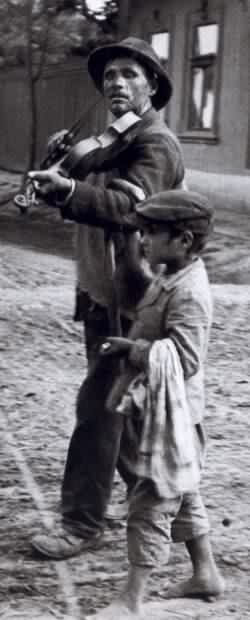
I've always found this image of a blind fiddler by André Kertész very evocative of Cioran's Transylvania, even if Kertész was a representative of the race whose only achievements, Cioran said, were gypsy music and Hungarian women.

From The Trouble with Being Born: 'No one has loved this world more than I, and yet if it had been offered to me, even as a child, on a platter, I should have shriked "Too late, too late!"'

Cioran (cont.)


More Cioran, this time from History and Utopia: 'Were I to seize power, my first concern would be to do away with all my friends.'

And an anecdote on Diogenes from A Short History of Decay: visiting the house of a rich man, the philosopher is told not to spit on the floor. Complying with the request, he spits in his host's face instead, saying it was the only dirty place he hadn't been asked not to clean.

Saints and Philosophers


A little Cioran to get the new year underway.

'All of the philosophers together are not worth a single saint', EMC writes in Tears and Saints.

And this even though 'The saints' goodness is repulsive. It is like a sickly discoloration combined with an emasculation of being.'

And more: Francis of Assisi's 'absolute perfection' is 'unforgivable'.

And further: we are lucky that Christ died at thirty-three and not sixty, or instead of the cross 'he would have left us a volume of memoirs.'

But the best thing about the saints: 'If you don't take an interest in [God], you could end up interested in mankind. Could you fall any lower than that?'

Sunday, December 31, 2006

Breakfast Will Not Be Served After Lunch


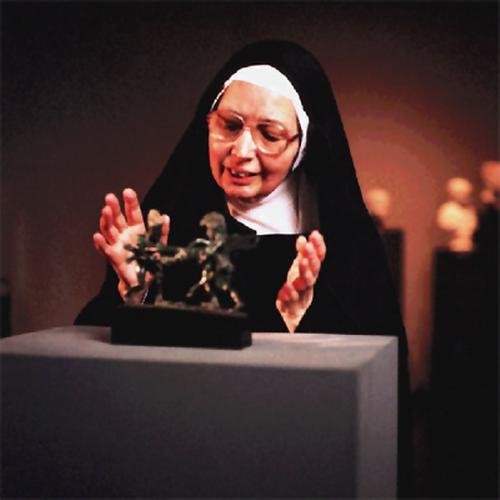
This is toothy television nun and consecrated virgin Sister Wendy. Consecrated virgin is to virgin what extra virgin is to virgin olive oil, I'm presuming. She rises between one or two in the morning. I mention that because, as a reader of George Szirtes's blog, I notice how his hour of rising keeps getting earlier and earlier. These days it's 3am.

If someone gets up at the same time I go to bed, who is up early and who is up late? I worry about these things though not, be it said, to the point of losing any sleep. I rarely go to bed before two in the morning and rarely rise before eleven the next day.

The idea of confusingly overlapping timezones reminds me of a sign in an Irish B&B: 'Breakfast will not be served after lunch.'

And so the year ends as bone-idly as it began.

Saturday, December 30, 2006

Cartesian Centaur


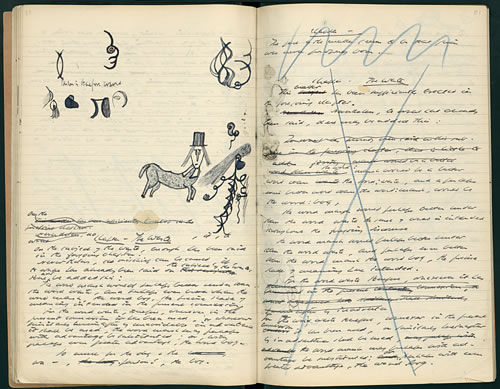
A Cartesian centaur, I presume. From the Watt manuscript at the Harry Ransom Centre.

Thursday, December 21, 2006

Komodo Dragon Virgin Birth


Flora the Chester zoo Komodo dragon has delivered herself of a virgin birth.

For God so loved the world, that having already used up his one son he sent an outsized Indonesian novelty living fossil.

Wednesday, December 20, 2006

Craze for Explicitation


Beckett fact no. 73.

Ten mistakes in Beckett.

1) ‘Not count! One of the few satisfactions in life!’ Dan Rooney expostulates indignantly in All That Fall. He wouldn’t have derived much satisfaction from the eighteen by fifty metre cylinder in the John Calder printing of The Lost Ones whose surface area is a paltry 80,000 square centimetres. Revising the height downwards from eighteen to sixteen, Beckett managed to bring the dimensions back in line with the correct twelve million square centimetres of the original Evergreen Review printing.
2) Still on the theme of innumeracy, ‘The figures given here are incorrect. The consequent calculations are therefore doubly erroneous’, we read in a footnote to Watt of the Lynch clan and its sadly unrealized millennial ambitions.
3) ‘Atlas, son of Jupiter’ Pozzo exclaims in the original text of Godot, where we now read ‘Atlas, son of Japetos’, someone having pointed out the mistake to Beckett.
4) Also in Godot, Vladimir errs in his memory of inconsistency in the gospel accounts of Christ and the thieves. ‘Only one speaks of a thief being saved […] Of the other three three two don’t mention any thieves at all and the third says that both of them abused him’, he says. Except that while Luke has one good thief and Matthew two bad ones, there are two silent thieves in Mark, and two men (not described as thieves) in John.
5) Christopher Ricks notices this one in Beckett’s Dying Words: that the ‘Grave’s disease’ mentioned twice in Murphy is in fact ‘Graves’ disease’. How hideous is the misplaced apostrophe.
6) The seven scarves quoted in the opening of Murphy, when only six are enumerated, not to mention the fact that tying one behind one's back is a physical impossibility: that's all just to make sure you're paying attention.
7) Is this a mistake? The narrator of Enough is identified by Martin Esslin and Vivian Mercier as a woman, between his references to penis-licking and breasts, but in the original French text Assez Beckett wrote ‘Si je m’étais retourné je ne l’aurais pas vu’, indicating that it’s a man. If this did strike him as a mistake, he corrected it by ungendering the sentence to ‘En me retournant je ne l’aurais pas vu.’
8) A Deborah Warner production of Footfalls was halted by the Beckett estate in 1994 for the athletic off-piste antics it handed to the normally foot-dragging May. However, where the original text specifies seven steps before she turns around, Beckett later fixed on nine. In Collected Shorter Plays he forgot to bring V’s step-counting in the text into line with the diagram of the nine steps, but all attempts by the Beckett estate to have Beckett's own productions of the play retrospectively banned for tampering with the script have come to nothing.
9) Very late in life Beckett contributed to a project called The Great Book of Ireland, which involved him copying the four lines of 'Da Tagte Es' onto vellum for the delectation of Charles Haughey and other political flunkeys back at home, but in his weariness/confusion/temporary (soon to be permanent) failure of the will to live, Beckett got the lines in the wrong order. Mistake though this was, it was as nothing to the trumpeting that followed of the quatrain as 'Beckett's Last Word', when it was obviously no such thing.
10) There's lots of back-and-forth 'he said'/'he said' dialogue in Mercier and Camier, so it's hardly a surprise that Beckett loses trrack of who's saying what, as he does on page 74 of the Calder edition. Camier has ventured out to test the rain:

Well? said Mercier.
Don't rush me, said Camier.
He advanced to the corner of the street, in order to reduce the risk of error. Finally he regained the porch and delivered his considered opinion.
In our shoes I wouldn't, he said.
And may one inquire why not? said Camier.

Unless Camier has taken to talking to himself, I'm assuming that last 'Camier' should be his partner in pseudcoupledom, Mercier.

And finally, not a mistake in Beckett, but revealing none the less. Looking for references to mistakes in Beckett I noticed a reference to this ‘craze for explication’ (from Catastrophe) in a 1994 Contemporary Fiction article by Therese Fischer-Seidel. Except that it’s a craze for ‘explicitation’, not ‘explication’. You never can be too careful!

Saturday, December 16, 2006

On the Menu


In Christopher Reid’s new book, Mr Mouth (Ondt & Gracehoper), the protagonist finds, on the menu of a greasy spoon café, something called ‘spaghetti bongolese’.

Am debating whether that tops my previous favourite restaurant trouvaille, 'aubergine stuffed by a nut.'

Friday, December 15, 2006

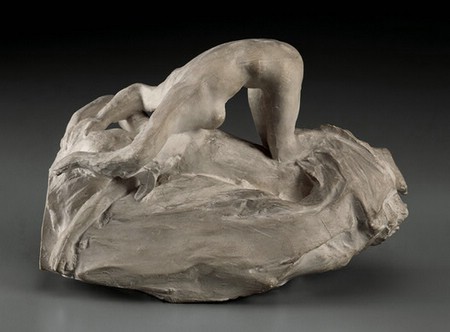
Anti-Tithonus


Rodin's Aurora and Tithonus


We are, Peter Riley writes in The Day's Final Balance – Uncollected Writings 1965-2006 (just out from Shearsman), 'eternal but we die.'

Thursday, December 14, 2006

Penguin Skittles


My brother saw these penguins on Gable Island, Tierra del Fuego.

PS Penguins do not crane their necks backwards and fall over when they see planes passing by. Or at least it says they don't here. They do, however, fall over when recruited for a game of penguin skittles, which I presume, privileged witnesses that we are, is what's going on above.

Gut of a Bloated Swine


I was reading a student essay the other day about poetry on the internet and came across the following sample, from a poetry site called Aha! (supply Alan Partridge joke here). It's about childbirth, apparently:

Partitioning your legs in fever,
Like the gut of a bloated swine,
But your chops has [sic] breathing machinery in it,
Not a cherry red apple,
And you are not basted in apple sauce,
But the sweat of your pores.

Monday, December 11, 2006

Artist and Audience


A poem, for Peter Riley, is ‘an object between poet and reader which is both a means of communication and a barrier to communication’, ‘neither opaque nor transparent’, a ‘body of light’ reflecting ‘the need to say and be revealed crossed with the need to remain silent and secret’. Glenn Gould suggested that the audience is to the artist as one is to zero, and in an appreciation of little-read 40s poet Nicholas Moore Riley goes further: ‘If poetry in this place is to have any half-decent future, it will have to be withdrawn completely from public view.’

Sunday, December 10, 2006

Tim Robinson


A riddle from Tim Robinson's Connemara: Listening to the Wind, a book I've been reading slowly, lingeringly:

Téann sé isteach ar ghuaillí daoine agus tagann sé amach ina shnáithín síoda – ‘It comes in on people’s shoulders and it goes out as a thread of silk.’

Answer in the comments stream.

Saturday, December 09, 2006

Wretched Stuff


Eric Griffiths chews on Sean O'Brien's brains and spits them out.

On the subject of there being no hills between Pisa and the sea, Stephen Dedalus looks at Bray Head from the tower in Sandycove in the first chapter of Ulysses, except he can't possibly do so; Killiney Head is in the way. He must taken taken a terrible brain-chewing over that from the books desk of the Freeman's Journal or the Wicklow People back in 1922.

Cynophagy


Is that the word? For dog-eating?

Reading Among the Christians sent me back to Empson's Christian-baiting essay on 'The Rime of the Ancient Mariner', where I picked up this tidbit:

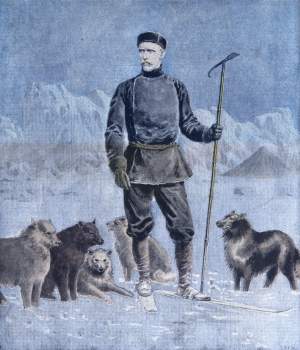
Take the philanthropist Nansen; all teams such as his had a schedule for eating the husky dogs who pulled the sledges, so that each time a sledge became empty, as the men and dogs ate the food on the sledges, there were no husky dogs to pull this useless sledge. I bet all those dogs loved Nansen like crazy.

Panda Sex Tricks


Jonathan Watts describes some panda sex tricks in The Guardian:

Another challenge was the risk of in-breeding. To widen the genetic stock, researchers had to come up with a way to find a mate for even the least popular females. How did they do that? "We tricked them," Zhang says with a smile. The "trick" is to put a fertile and attractive female into a breeding pen, where she leaves scratchmarks and droppings capable of exciting a male. But at the last moment the females are swapped. The zookeepers introduce a new, less popular, mate who has been scented with the urine of the more attractive animals. She is introduced into the mating pen rear end first, so the male cannot see the face of his partner until after they have finished copulating. "When the males find out, they get very angry and start fighting the female," Zhang says. "We have had to use firecrackers and a water hose to separate them."

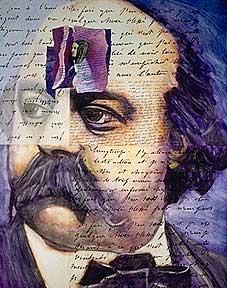
Flaubertian


Julian Barnes introducing a French edition of Le Sottisier, Flaubert's projected second volume of Bouvard et Pécuchet:

Le dimanche 28 Novembre 1852, à cinq heures du soir, Flaubert s’assit à son bureau pour rédiger sa critique péremptoire du poème de Louise Colet, ‘La Paysanne’. ‘Je vais vous noter tout ce qui ne me paraît pas irréprochable’, commença-t-il. Au bout de six heures (seize pages de correspondence de l’édition Pléiade), après une série de critique blessantes, il conclut: ‘Tout ce que je n’ai pas remarqué me paraît bon ou excellent.’