Site Meter

Thursday, July 22, 2010


Wednesday, July 21, 2010


Thinking About David Jones

Like the figure of his Aphrodite, David Jones intended his art to have both a sacrificial and ecstatic function, a synthesis for which only wartime, it seemed, could provide the necessary conditions of intellectual emergency. The name for the highest form of art in Jones's lexicon was ‘sacrament’. In his essay ‘Art and Democracy’ Jones wrote that if only the beaver would add one superfluous twig to his dam it would become ‘a font’, and ‘the creature would enter the “sign world”’. The form of this ‘sign world’ is the artistic sacrament or anathemata, ‘the things set up’ to affirm and exalt ‘the gods’.
Monday, July 19, 2010

Caravanserai

The Sahara has shifted
an inch and a continent.
The dune you are standing on,
Ibrahim Ag Alhabib,
is also thousands of miles
from your feet: my windscreen
this morning is coated
in fine desert sand.
Never was shifty heart truer,
or truer to it its far-scattered sons
who touch across oceans of sand.
Among themselves
the Touareg are the Imazighen,
‘the free people’. In Arabic
‘Touareg’ means ‘forsaken by God’.
The sandmen of my youth
are forsaken by the Fassaroe pit,
the last gravel mixed
and the compacted fill
rolled flat. I see again
the brace of wheels
on the weighbridge, the great
engines ticking over,
at bay, and dust
that is no longer sand
in the drivers’ eyes.
I feel its drift, voiceless
and huge, within me,
and know I too
am transported, grain
by grain, and unsigned for,
the docket still in my father’s hand.
Over that brutalized earth
I see the tippers void
the rising clouds of their sandstorms,
a caravanserai
of transients negotiate
sand trails decades since
sand was there:
their mounts departed,
not a Thermos between them,
they and their shallow pits
soon exhausted, tiny-seeming
under the stars.

Sunday, July 18, 2010

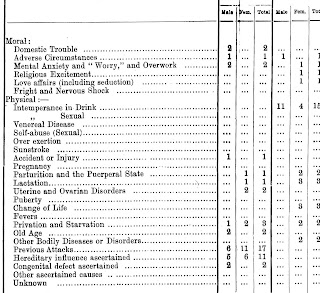
Report of the Hull Borough Asylum for the Year 1885
Courtesy of a most intriguing publication I picked up today, the Report of the Hull Borough Asylum for the Year 1885, a list of grounds for summary detention for feeble-mindedness in the late nineteenth century. Good to see an over-enthusiastic bout of self-abuse could land a man in the madhouse back then, in theory at least, even if the 1885 figures show a deplorable shortfall of lunatic masturbators banged to rights. If only these humanitarian sages had been around to help me through my teens. It’s not too late now, even, I suspect. A letter to the Hull Daily Mail may be in order.

Saturday, July 17, 2010

Thursday, July 15, 2010
Hessle Road
You can give a man a better new camera but say what you like, the world will always need bad photographs. The Wassand Arms here used to boast a dancing parrot, but no more. There is a parrot in The Ship in Sewerby, but does anyone know of any remaining resident parrots in Hull pubs? I wanted to get pictures too of The Stricky Arms and Rayner’s, redoubtable old watering holes of ill repute, but there were people standing in the door and I didn’t like to disturb them. The pub with the beautiful old Anchor Brewery sign (Anchor Brewery of steam beer fame, presumably?) is The Dairycotes Inn. The Criterion was of coursed named after the literary journal. Geoffrey Hill’s early/late Eliot pitch/tone debate is a very popular theme there, I discover. In fact they speak of little else. Click for big.


Wednesday, July 14, 2010

The Letters of Louis MacNeice

Monstrously long review of The Letters of Louis MacNeice, by me, here. Now there was a man who loved cats.
Subscribe to:
Posts (Atom)