Site Meter

Wednesday, March 14, 2018

‘Sometimes I imagine /they speak’: A Note on Richard Wilbur, George Oppen, and the Political Poem


When Richard Wilbur is linked to modern Irish poetry, it is usually by way of his influence on Michael Longley and Derek Mahon, who read his work as students in the 1960s. Poetic dandy that he was, he is often cited as an exemplar of the artist who turns to poetic form as a buffer against the rougher pressures of history and politics. By extension, careful formalism such as practised by Wilbur is often seen as an a priori conservative stance. This is not necessarily the case, and Wilbur wrote his share of poems expressing anger at the Vietnam War, such as ‘On the Marginal Way’, which reaches back to the holocaust and the Spanish Civil War to channel the poet’s rage at the ‘tidings of some dirty war’, and ‘A Miltonic Sonnet for Mr Johnson’, comparing Lyndon B. Johnson unfavourably with Thomas Jefferson. When asked for a poem by a student newspaper in 1970, however, he wrote ‘For the Student Strikers’, published only after some consternation and delay. It’s not hard to understand the negative reaction it provoked:

Go talk with those who are rumored to be unlike you,
And whom, it is said, you are so unlike.
Stand on the stoops of their houses and tell them why
You are out on strike.

It is not yet time for the rock, the bullet, the blunt
Slogan that fuddles the mind toward force.
Let the new sound in our streets be the patient sound
Of your discourse.

Doors will be shut in your faces, I do not doubt.
Yet here or there, it may be, there will start,
Much as the lights blink on in a block at evening,
Changes of heart.

They are your houses; the people are not unlike you;
Talk with them, then, and let it be done
Even for the grey wife of your nightmare sheriff
And the guardsman’s son.


The poem calls for civility, respect and dialogue, while placing the responsibility for these qualities on the side of the protesters, whose anger places them outside civil norms. In their righteous indignation, they lose sight of their enemies’ humanity. (Small contextual reminder: also in 1970, four student protesters at Kent State University were killed by the Ohio state guard while protesting US bombing of Cambodia). Once they have calmed down, the protesters can drop round for some dialogue to the nearest policemen’s houses, at the risk of doors being shut in their faces (rather than, for instance, rifles being discharged in their direction). Why didn’t Arthur Scargill drop round to Ian McGregor’s house for a cup of tea during the miners’ strike? Why don’t Black Lives Matter protesters stop by their local police sheriff’s department for a friendly chat? The suggestion is comical, ludicrous even. In a political stand-off, why should it be the responsibility of the protester to accept the civilised norms of the governing class? Are these really so self-evident that a departure from them requires the policing (metaphorical and literal) of Wilbur’s poem? It is the perennial Antigone question, of why the arbiters of power and authority should be the ones to decide what constitutes civil protest and reasonable resistance to the rule of law.

The poem retains the power to provoke today. Writing this short essay, I see it was posted with a commentary on Eratosphere by A. M. Juster in 2016, who hailed its relevance against the mass erosion of civil discourse that greeted the election of Donald Trump, by which he meant the language of anti-Trump protesters. Juster has elsewhere underscored the political bona fides of Wilbur’s poem by describing its author as otherwise ‘not a conservative poet’ and ‘a poet from the far left’, which will come as a surprise to many. It’s also worth adding to the mix here that I have interacted quite a bit, with A. M. Juster on the internet, who is a regular and thoughtful commentator on poetry on twitter. Our discourse has certainly remained within the terms of the concept I am trying to unpick and unpack here, the ‘civil’.

Wilbur is not alone in responding to political conflict in these terms. A striking poetic disagreement from this same period occurred between Denise Levertov and Robert Duncan. The former had begun to write protest poems against the Vietnam war and the latter, whose politics were of a libertarian left/anarchist hue, objected. He found them didactic and brow-beating. The two exchanged many letters on the subject and their friendship suffered badly. Duncan’s attitude is probably best expressed in his oft-quoted suggestion that ‘The poet’s role is not to oppose evil, but to imagine it.’ One poem that especially riled Duncan was ‘Tenebrae’, with its description of suburban Republican wives, whose distance from social conflict draws the disapproving comment from Levertov that ‘They are not listening’. Evidently feeling got at, or accused of not tuning in to the correct radical frequencies, Duncan tells Levertov that ‘I am listening and hearing more than you consider it legitimate to hear’. He insists that the proper task of the artist is to follow where his art leads him, and not to presume artistic merit will lie where political virtue signals its presence. He is accusing Levertov, in contemporary parlance, of ‘virtue-signalling’ – a problematic objection, I find, when shadowed by what we might call reverse virtue-signalling, in which a conservative reader insists that political engagement can only be bad for a poem, leaving all virtue on the side of the unexamined status quo. This is certainly not Duncan’s position, though his actual views about the climate of the Johnson-era US are perhaps better illustrated by his decision, in 1968, to stop publishing for fifteen years, a promise he duly honoured.


Which brings me to the case of George Oppen. Though sharing with Wilbur the experience of wartime combat in Europe (Oppen narrowly avoided death in a foxhole in Alsace), he had followed a radically different path and career from the younger poet. After the publication of his elliptical debut Discrete Series in 1934 and association with the Objectivist poets, chiefly Reznikoff and Zukofsky, Oppen responded to depression-era US politics by joining the Communist party and giving up poetry, becoming a labour activist instead. After the war, the Oppens came under political suspicion and moved to Mexico, where George worked as a carpenter. Newly returned to the US, he was 54 when he resumed his poetic career with The Materials. Unlike the much-garlanded Wilbur, Oppen was no one’s idea of a career poet, and reacted to his surprise Pulitzer win in 1968 by, for his own eccentric reasons, striving to give as few poetry readings as possible. Yet for all Oppen’s record as a political activist, he makes for a very uncomfortable political poet, as judged by contemporary standards. Critics who express scepticism of political poetry will often identify it with sloganeering, of the kind one might write on a placard at an anti-war protest. Oppen had no sense of such a conception of poetry. He was deeply puzzled by the Beats and other expressions of 60s counterculture. For Oppen, the poem is not a site of opinionation, but a site of witnessing, of hospitality to available reality. As David Herd writes: ‘Oppen would have liked a poetry totally without the inflections of voice, a poetry that understood its objective to be an almost silent, largely impersonal rendering of things.’ Oppen was fascinated by Heidegger, and can often appear to strive for a state of mystical Dasein, or revelation of ‘being-in-the-world’, in his poems. The contrast between Wilbur and Oppen is most obviously apparent on the level of the individual line, and what each poet thinks it is, and can do. Oppen does not use rhyme, and has no real use for the pentameter line. His line-breaks are, to a dispassionate observer, often arbitrary and jagged, serving to thrust into prominence the object of contemplation.

Nevertheless, politics are abundantly present in Oppen’s work. The poem that has prompted me to write this note, ‘The Book of Job and a Draft of a Poem in Praise of the Paths of the Living’, marks a particularly painful encounter with 60s politics, in the form of the murder in Mississippi of three civil rights activists, James Chaney, Andrew Goodman, and Michael Schwerner, engaged in voter registration (their killings form the backdrop to the film Mississippi Burning). The poem is dedicated to Schwerner, whom Oppen had known in New York, and the poem begins with an ambition to ‘name Goodman Schwerner Chaney/who were beaten not we/who were beaten children/not our/children ancestral/children rose in the dark.’ But it is they, not we, who have suffered,, and that bridge of difference is one the poem finds it tricky to cross. In his study George Oppen and the Fate of Modernism Peter Nicholls describes the poem’s tortuous composition and publication history, as Oppen circled round this problem, before its reaching a final form in Myth of the Blaze, a collection incorporated into his 1975 Collected Poems.

One basic difference between Wilbur and Oppen is the latter’s habitual dissection of syntax. In conversation with Lawrence Harvey, Beckett said he felt driven to slice up his own poetic syntax for reasons of ‘shame’, and with its stuttering sub-utterances Oppen’s poem gives every impression of an abashed inability to confront its subject and have its say. The reference to the angry ant derives from a letter of Francis Drake’s to Elizabeth I, in which he warns her that the wretched of the earth will not be patient forever but will rise up and have their vengeance:


And then there is the question of the Book of Job. Oppen’s relationship to Judaism is a huge topic, and not one I can fully ventilate here, but his reading of the Book of Job is, it must be said, pessimistic. Job has had a rough old time of it, but nothing God says approaches an apology. One reason for this, according to Oppen (waxing gnostic), is that it is not God who speaks but the demiurge, the malign god of creation. In his notes on the biblical text, Oppen gives no sense of being impressed by God’s self-defence. Up to now, Job has been the victim of a cosmic order that seems vicious and irrational. Now it is spelt out as a moral code, while retaining its violent irrationality. As Nicholls observes, drawing Blake into the discussion: Truth, we might say, falls outside of the apparent contraries of ‘moral virtue’ – it is not about theodicy, the justification of God’s ways to man, but about the material presence of the world, the creative force that speaks from out of the whirlwind, the force that, as Blake has said, creates both the tiger and the lamb and cannot be held to account for its actions. Truth is rather that ‘moment of sincerity that dislocates everything’, a sincerity, that is, that equates not to an individual’s intentions but to the actuality of the world itself.

Although God restores Job to prosperity, Oppen sees continuing violence in the moral order that he represents, just as he does in the vacuum of anarchy he has allowed to invade Job’s life. As he stresses in his notes on Job, the remarkable thing is that Job has provoked God into speaking at all, but the dignity we wish to see restored to Job comes from his own articulation of his woes, not from his accepting a restored place in the violent cosmogony of the Old Testament God. These private responses to Job find oblique expression in the poem. Here as elsewhere Oppen identifies with states of reduction, smallness, poverty, frailty, shabbiness, insubstantiality. As the ‘storm’ passes, some will survive and ‘we /the greasers’:

survivors will be tame
will stand near our feet
what shall we say they have lived their lives
they have gone feathery
and askew
in the wind from the beginning carpenter
mechanic o we
impoverished we hired
hands that turn the wheel young
theologians of the scantlings wrecked
monotheists of the weather-side sometimes I imagine
they speak

‘We /the greasers’ references a derogatory slang term for Hispanic immigrants to California, and its ‘we’/‘they’ vacilliation provides this section with its own commentary on Oppen’s solidarity with, and simultaneous separateness from, the migrant labouring communities of his adopted state. The bystanders and observers will not be sharing our testimonies of the violence done to them, nor will ‘we’ be seizing the microphone to broadcast our political thoughts. Perhaps those in the deep south will see this ineloquence as blameworthy (Levertov’s ‘They are not listening’ again), but the poem leaves it at imagining their speech, rather than recruiting them as vehicles for its indignation.

The experience of the storm leaves the survivor with a residue of ‘shame’, which ‘touches him /again arms and dis- /arms him meaning /in the instant //tho we forget //the light’, with social conflict once more ascending into a realm of ontological light and dark, revelation and concealment. A passage of landscape writing resounds to the ‘camera’s click’, a material trace of an alien, observing eye that we might (for instance) visualize as the civil rights workers recording the injustices of the deep south. The writing is, still and ever, brittle and self-fragmenting in rendering a:

tragedy so wide
spread so

shabby a north sea salt
tragedy ‘seeking a statement

of an experience of our own’ the bones of my hands

bony bony lose me the wind cries find
yourself I?

this? the road
and the travelling always

undiscovered
country forever

The poem approaches only to reject the commensurability of tragedy and the lyric vessel of the ‘statement’ it might provide. The site of colonial violence in Conrad is a Heart of Darkness, and Oppen’s description of the land as an ‘undiscovered /country forever’ echoes the jaded language of ‘civilised outrage’, while self-consciously refusing to present itself as the enlightened discoverer of what it is that drives the primal violence of American life.

The poem ends instead with an act of radical entry into its landscape and its memory, extracting from it a harsh music in which the present becomes coextensive with the past (time past is ‘not ended’) and the landscape a text we can both read and write upon. There is no ‘I’ in the closing verse paragraph, though a ‘we’ does feature briefly. More importantly, ‘in itself /of itself speaks the word’: objectivist self-sufficiency of the word is achieved at last:

mid continent iron rails
in the fields and grotesque
metals in the farmer’s heartlands a sympathy
across the fields
and down the aisles
of the crack trains
of 1918 the wave
of the improbable
drenches the galloping carpets in the sharp
edges in the highlights
of the varnished tables we ring
in the continual bell
the undoubtable bell found music in itself
of itself speaks the word
actual heart breaking
tone row it is not ended
not ended the intervals
blurred ring
like walls
between floor
and ceiling the taste
of madness in the world birds
of ice Pave
the world o pave
the world carve

thereon…

I would summarize the contrasting effects of Wilbur’s and Oppen’s poems as follows. Wilbur’s subject matter may surprise the reader, but his poem exists on a recognisable spectrum with his usual lyric poise and wit. This makes it all the more startling then that he so blithely enlists these qualities to a discourse of civility so transparently forced and unsustaining. ‘Rumoured to be unlike you’ – so it is the protesters who have a problem with difference rather than the police? The unloading of touchy difference onto the students recalls the contemporary insult of ‘identity politics’, where it is the self-engrossed womanhood/blackness/whatever of the protester that disables their capacity for reason. What of the identity politics of sameness, of the inert and monstrous Leviathan – what of the reality of murderous state violence? These concepts escape Wilbur’s poem and the available reality it conveys. I find it a finally small and cowardly utterance.

Oppen’s poem is born in private recoil from the wound of political violence and fashions from this a meditation on good and evil. How do the wronged assert themselves in the face of political evil? Is it for Oppen to give them a voice or do they speak for themselves? The poem ponders hard the conditions of its own making before entering, tentatively, the in-between state where understanding and solidarity become possible. But what it is we ‘carve //thereon’, in the poem’s lapidary conclusion, is not spelt out, remaining shrouded in the Job-like whirlwind of history. The poem ends on a note of continued scattering and loss, stating its moral imperative but alive to inadequacy and failure too. Oppen’s is the harsher poetic environment than Wilbur’s, yet strangely more welcoming where questions of politics and history are concerned, more open to the possibilities of understanding and change. It seems to me exemplary of what a modern poem can be in the face of politics and history, of the traces they leave on us, and the traces we in return can hope to leave on them.

Saturday, November 19, 2016

Work in Progress, or Mr Smacky Paw (Slight Return)


Whereas it might be urged that our progress, findings and pronouncements followed neither sequence nor method, the truth is arguably, given the right combination of arguer and arguments, of arguer and arguments and audience – is arguably quite other. Travel fatiguing us (there being few things we found less to our taste than travel), we debated, my associate and I, with our feline advisors (then lying between us), whether our purposes might not be as easily accomplished by going, not here, there or there, but nowhere; with due allowance made for rolling now this way, now that, as our cramps, bed sores, or our feline advisors’ whims dictated. As we debated, a shadow continued on its way from the far edge of a wardrobe to the near edge of the door. I remember being struck by this, to the point of wishing to make a note, and remembering my pencil had unfortunately rolled from the bed and onto the floor, onto the floor and under the bed, where it lodged just out of reach. Arising from my recumbent position to retrieve it I placed one foot before the other – so – prior to kneeling down, only to find my progress checked by the actions of Mr Smacky Paw, otherwise Percy the cat. I passed the bed-corner, very slowly fleeing, and smack! went his paw against my trouser leg. I took a step backwards, out of shock and the better to register what had just happened, and smack! it went again: smack! Now forwards again I went, attention divided between the rewards of the window and the experiment on which I found myself embarked, and smack! went the paw a third time. Fart!, went Sam, another of our feline advisors, looking on from the other end of the bed, fart! though not in a manner of suggestive of any causal connection between my advancing and retreating, Mr Smacky Paw’s reaction to this, and the release of a small quantity of gas into the bedroom air. Then just as the fart, this modest fart, by no means pungent or exceptionable, just as this fart had supplanted the smack in my mind, roll! went Jessica the cat in her median position on the bed between the two other cats, from this side to that, and back again from that side to this. But such was my state of rapt attention to Jessica’s roll, coming on top of Sam’s fart, coming on top of Percy’s smack, that standing there as I was, like a great big gawm, I found myself smacked all over again, for no crime at all, neither of forward nor or rearward motion: smack!, went Mr Smacky Paw, with perhaps enough force to concuss an infant dung beetle or ladybird, but causing me, to speak of me, the recipient after all of this blow, something closer to bemusement than annoyance, but interruption and inconvenience too, since but for the smack I would long since have retrieved my pencil, enjoying a momentary view from the window preparatory to my kneeling down, that too, a view of the field, its line of woods in the distance with sometimes a buzzard or two overhead, sometimes not, but still, a view, a genuine view, not this hell of trouser-tugging molestation with attendant farting and rolling and, can you believe it, while I was thinking all this, pfft!, went another Sam fart, and left-right, right-left!, went another Jessica roll. I retrieved my pencil and returned to bed, confirmed in my earlier suspicion of the madness, madness I say, of venturing abroad under these or indeed any conditions.

Sunday, August 21, 2016

Enuresis


after Jean du Chas

We are exploded!
Hellish contraption en route to Haydn’s creation
bearing me along on the bier of her thoughtstream

she tore off a snowwhite cockade from her Bourbon unmentionables
the Bari Madonna shedding her gewgaws by clockwork

who but a Khan would not affect pyjamas
knucklebones cracking like hailstones on the skylight?

a most inept catechumen
doffing his cap to a shooting star
a null place, a spacious naught
an inside fob pocket voice

cover your goitre, my scarlet armed rusty haired bovine
the goodwill of this lousy old earth is venery against thee
the laurel of unknowing on my distempered head
insensible in a deathstupor

I have – glory be – a competency
that oft posed question
a ptyx of bitterness
garrotte me with her garter
turgent bubs
promulgated by a sowgelder
oh mine, my own sweet bowels!

(I hereby atone for myself
I willed and pronounce it
my blighted ipsissimosity
semel et simulacrum
an antidote to all content)

what is this life but an Irish sea
I stiffly asseverate
melancholy as a leveret
a laden head & a leaden behind
the eunuchs as usual in the thick of the shenanigans

coil my law round thy tarsals
punctilious buck of a young gallant
the undevirginated young ladies in Holland glide on the ice

Sweeney on Eigg


i
dark sky
darker sands       to circum-
ambulate       the island sets
the compass points spinning      catches
the Massacre Cave      the standing stone
off-guard      they scamper ahead of me
to their places

ii
gewgaws of       island
kingdoms      a necklace with no chain
a god’s dowry scattered      the water-
colourist’s palette       greens purples
browns       upended veining
the burns       sprouting
a rainbow from the tap

iii
millstone of the centuries
turning       improvident demons
of cloud draw blood       from the peaks
the edge of the candlelight too       is jagged
my bothy’s welcome shall be defenceless
only the      boarded-up house
locks its door

iv
select aperture
select brightness       and contrast
each morning       the neighbouring island
presses its face      to the window
each afternoon      the ferry lowers
its tongue       to the pier
a cow at a salt-lick

v
arrowheads of gull-
prints       fallen in showers
have been       discovered since
the last tide      excavations
continue      the sands’ archive
of forgetting       remembers all
my forgetting

vi
storm-felled trees
our shelter      capsized hulls
by the pier      my life-raft
a curse blows me here       and drives
us hence      my birthright island
roots me       in earth my feet
have yet to touch

vii
my bothy
has no mirror       the curse
is incomplete so long as       I cannot
see my face      a few poor whimpers
escape us       lose themselves
in what       the sand sings and
singsand       singsand

Friday, August 19, 2016

Verlaine: Ars Poetica


Death to the white-guy heteronormative
bourgeois lyric. It sinks and I soar.
Untune your MFA-schooled tin-eared
competence and give us an auld tune.

So you’re the English language: want to make
something of it? This isn’t afternoon tea
at the Savoy. As for what it all means
I’ll leave that to you, soft lad translator.

Hymn with me the joys of unknowing: your eyes
behind a Touareg’s veil; summers in Goole;
a cat’s mucky footprints across a grant
application for a poem about autumn.

Because what we want’s head-fuck, nothing
but head-fuck, not the whole finding-his-voice,
one-of-our-most-trusted poets malarkey,
but moving to Yemen, orchids at the North Pole.

It’s no go your jokes at the reading, to limp
nervous giggles. End all your lines with ‘the’;
savage your friend’s new book; trace scar-lines
on the cheeks of your suburban epiphanies.

Away with a way with words: snap the neck
of eloquence like a wishbone and where
that headless chicken leads, follow. The blood-
jet of poetry spouts the purest free verse.

Rhyme, you canary courting a hippo,
stop telling me one thing chimes with another.
Nothing connects. Step out of line and it’s
a potshot to the wrist for you too, mate.

What we want’s ruckus and crash bang wallop,
a Pteranodon’s mating-call, or Mozart’s
Queen of the Night played on the Voyager probe:
anything out of this world – that or silence.

You up for it, philistines? Lick my spondees
and make sense who may. Have you even tried
being a genius? It sorts most problems out.
Anything else is The Norton Anthology.

Saturday, August 06, 2016

On the Nature of Landscape as Quotation


Though I might wish to dispute it, the statue of Robert the Bruce outside Marischal College is not holding up the Declaration of Arbroath for my personal benefit. He’s not really looking at me. Yet there he is on his horse, a herring gull posed on his head. Likewise, the statue of Gordon of Khartoum outside the gallery has no deep thoughts on its French Impressionist holdings. The statue of Victoria at Queen’s Cross has no demonstrable thoughts about anything. You may have seen one just like it, or close enough. She is there but not really there. All landscape is quotation. Further out from the city centre:

the Aberdeenshire canal
(1805–1854)
continues though dry, and where
should be bargefuls of granite
clearing the culverts and locks
are filled-in bridges over fields,
the trail coming and going.
Water remains available
but spurned yet

closer to where I live in the countryside, it elects to resurface in a short, anomalous stretch behind the Italian fish and chip shop in Port Elphinstone. It is August and the grass and nettles are overgrown, but a path has been trampled down to the water’s edge, where I find a duck on a log and not much else. I cannot see where the water begins or ends.

As an absence the canal repeats the paths that would have been there before it, now doubly lost, but snaking back from absence to presence it goes somewhere else again – not found, exactly, but diverted beyond municipal utility and marked deletion alike. Pushing the low branches of a beech tree aside I find algae, plastic bags, and clumpy growths of celandine. Rendering the canal obsolete, the age of steam will surely never die, I tell myself, before I turn back to:

where the waste
from the closed
paper mill gathers
the surface now
frothing now
placid and since
there must
be something
to look at
accept this duck
returning my gaze
from its nest
and a single egg
beneath it dead
but looking
ever so comfy

Sunday, May 29, 2016

Zone Out So Not


Occipital flange sublates pump-action
metonym, barking impasto left rib.
Utter vile cinnamon incidents’ throb
relaxed shale reserves into zinc trash-can.

The the of an an, bleats cryptographer
bare-cheeked to void slick colons as one:
spandrils adjusted to fuckwits’ paean,
kid yourself grave and the ghost flea graver.

Ooh but for ah be said non-responsive,
clitoris thermals rendered in marble paste.
Indigene tags identify Cheyenne,

splicing the axes of choice and combination.
Same again drainage by phoneme, once I’ve
finished with you; the premium yokels laid waste.

Sunday, May 22, 2016

The Author Recalls An Unfortunate Incident From the Days of His Youth


I am as correct as the next man as to my wardrobe, I like to think, and making my way to the bus-stop one day was distressed to find not just the tip of my necktie protruding from under my jumper but, how much worse again, the tip of my penis peeping over the top of my flies. Concerned to do a good job of rearranging my vest and trousers I found myself, for a brief second and a brief second only, exposing my entire wee willie winkie there on the street-corner, when to compound my woes I noticed a herring gull bearing down on me with some speed from the roof of an adjoining Methodist chapel. Thankfully I had to hand the text of a lecture I had delivered that same morning to the local Rotarian club on developments in the contemporary Irish lyric poem and the ‘post-Celtic Tiger generation’, and used this to discourage the malevolent scurrie; but to no avail. In no time at all, amid much wriggling, tugging, and other general shenanigans, his greedy yellow beak had connected with my puir wee winkie. Would he bite, suck, snap or yank? I hoped, naïvely, not to linger long enough in this undignified embrace to find out. But, woe is me!, even as I struggled with my laridian foe a packet of tofu wieners I had been carrying in my shoulder bag became dislodged, and, given the damage its packaging had suffered in the general mêlée, a 12-inch specimen shot free of the bag and into my mouth, causing me to gag; during which fresh indignity there was, alas!, no let-up from Mr Herring Gull, whose beak action I could now characterize without fear of contradiction as tugging, most definitely tugging. How indecorous and absurd a tableau I must have presented to passers-by, with the herring gull pulling on my puir wee winkie in a kind of seesaw rhythm with the motion of the tofu wiener, wedging itself Excalibur-like ever further down my throat; but not quite as indecorous or absurd as I would shortly look, when, in my disorientation, I fell backwards onto a small bollard, whose truncheon-like tip succeeded, can you believe it, in piercing the back of my trousers and jamming itself up my waiting rectum. Though I hesitate to impute spite to a mere herring gull, the close-quarters eye-contact I was by now enjoying with this pox-ridden specimen had acquired an unmistakable element of grudge and aggression. I nevertheless spared a thought for my surroundings, and the confusion I would inspire in any of my acquaintances, should they happen to be passing – my fellow congregationists, for instance, or a member of my bridge club – not to mention my inability, given the wiener in my mouth, to explain how I had come to find myself in this unfortunate position. On and on went my ordeal: wee winkie in herring-gull beak, wiener in mouth, bollard-tip in rectum, with me swaying now backwards now forwards, now up now down, from bollard to gull, from gull to wiener, from wiener to gull, from gull to bollard, from bollard to wiener, from wiener to bollard, nnngghumpfff, my choked cry of protest dying on my tongue. And though I have now, who knows how, extricated myself from this unseemly imbroglio, and gone on to lead an emotionally rich and fulfilling life, I did not escape without scars; and even today, I have only to read, hear, or think about the contemporary Irish lyric poem, with particular reference to the post-Celtic Tiger generation, to find myself back on that street corner, a herring gull yanking on my wee winkie, a tofu wiener molesting me per buccam, and an obstreperous bollard lodged in my rear passage; the only effective remedy for which, I have found, down the years, has been my painstaking translation (not intended for publication) into acatalectic hexameters of that masterpiece of Scottish Renaissance Latin humanism, George Buchanan’s three-volume Epigrammata.

Thursday, May 28, 2015

A Thief I’ll Not Be


after Abul Aba ’Al Ma’ari: Syrian, tenth century


You are diseased in
understanding and belief.
Hark to my words: meat
is murder. Let the creatures
continue in their being.

And fish is meat too.
Milk is for animals’ young,
not you. Squeeze some from
your own nipples if you must.
Bird’s eggs belong in the nest.

Theft is injustice,
the worst of crimes. Why should bees
fill their honeycombs
for you to come raid them? Their
plenty is not your pantry.

This knavery I
foreswear: a thief I’ll not be,
sorry only I
couldn’t have done the right thing
long before my hair turned grey.

Friday, April 24, 2015

‘Name Your Realities’: Thoughts on John Riley


John Riley was five years Geoffrey Hill’s junior, and at the time of Riley’s tragically early death in Leeds in 1978 Hill was still teaching in that city. As it has been Riley’s fate since then to have slipped into the bracket of the neglected poet, I’d like to exploit this slender connection to quote Hill on the subject of poetry and value. Contrasting Locke and Ruskin on the subject of intrinsic value, Hill unexpectedly sides with the former against the latter. Sceptical of forms of ‘intrinsic value’ that cling on far from the marketplace, he writes:

One is put in mind of the fate of certain elderly authors who, rescued from oblivion by coteries and the editors of small-circulation journals, are invariably described as having been hitherto been ‘strangely’ or ‘unaccountably’ neglected. The ‘neglect’ by some kind of imaginative fiat is simultaneously held to be both their ‘documentary claim’ to present notice and an intrinsic part of the ‘neglected’ author’s newly proclaimed value. A vicarious solipsism is also a demeaning charity.

I quote these lines in a spirit of caution, as we approach the much-needed rehabilitation of Riley’s work. Hill’s impatience with the dull exhuming of ‘strangely neglected’ topics is perhaps the closest he ever gets to a Lucky Jim impersonation, but in his sceptical way he raises at least two issues we do well to separate carefully. The first is the extrinsic dimension to Riley’s neglect – the factors that conspired to make the relegation of his work not so strange or unaccountable at all in the climate of 70s British poetry and its aftermath. This is the period, after all, of the post-Mottram retrenchment at the Poetry Society and the rise of the Martians and the Northern Irish poets – not, any of them, developments much in tune with the spirit of Riley’s work. Riley entered the 1980s with a now impossible-to-find Collected Works, published by Grosseteste Press, and when he achieved the leg-up of anthologization, in Crozier and Longville’s A Various Art it was courtesy of Iain Sinclair’s Paladin list, most of whose stock was pulped shortly afterwards. The second issue I pick up from Hill is the intrinsic singularity of Riley’s work and its determination to follow its own path, with little interest in any ‘documentary claim’ on our attention. Riley’s work is unshowy by temperament, and many of the terms in which we couch praise today – vibrant, representative, edgy – bounce off his poems without much purchase. Something more is required. This is the challenge Riley represents, and one it will take more than ‘vicarious solipsism’ to meet convincingly.

Russia, subject of Riley’s longest poem, ‘Czargrad’, seems a good place to begin. I’ve mentioned Northern Irish poets, and Seamus Heaney’s engagement with Slavic poetry was one of the most visible stages of his elevation in the 1980s to global sage. This engagement involved tracing parallels between poets writing in the shadow of conflict and tyranny, and making the case for poetry as a redemptive act of witnessing. While some found an appropriative dimension to Heaney’s Slavic excursions John Riley represents the more rarely observed phenomenon of cultural expropriation – self-expropriating, in fact, in his conversion to Russian Orthodoxy. My remarks on this subject are founded largely in ignorance, as I will now demonstrate by citing the episode of Seinfeld in which George Costanza converts to Latvian Orthodoxy to please a girlfriend. Asked by the Orthodox priest what aspect of the faith he finds attractive he replies, ‘I think the hats’. The serious point here is our tendency to eroticize Orthodoxy into a theatre set of smells and bells, of chanting bearded elders, and stern-faced Christs on Tarkovskyan icons. John Tavener’s appeal, one might suggest, is a symptom of this tendency – if the Anglican hymn-book seems too twee to inspire great religious art these days, our high-mindedness can still acquire a new lease of life when outsourced to an Orthodox ‘Liturgy of St John Chrysostom’. As I’d like to stress, Riley’s example pulls strongly against any such touristic tendencies, as well as connecting with a long tradition of Western Slavophilic thought. Vladimir Soloviev’s nineteenth-century syncretic mysticism was a major influence on Hugh MacDiarmid, as well as providing Riley with the epigraph for his 1970 collection What Reason Was: his philosophy of ‘sobornost’ stresses community over individual and revelation over scholasticism. In a letter to Michael Grant of 1976, Riley echoes this when he denounces the ‘Larkins and Brownjohns’ of modern verse, and poetry that ‘comes out of the “individual”’ with its presumed ‘“authenticity” of the self’.

Revelation takes place on a higher plane, then, than that of post-Enlightenment selfhood. In Tarkovsky’s Andrei Rublev, this revelation takes the form of Rublev’s icon-painting. An oddity of that film, for a portrait of the artist, is that it never shows Rublev at work: he throws a bucket of paint against a wall at one point, in frustration, but spends much of the film in a state of moping frustration and self-pity. He also has the Tatar invasions to deal with, I should add, but then at the end of the film black and white becomes colour and we witness the ravishing artefacts the real Rublev produced amid so much chaos and death. The transition from these miseries to the redemptive grace of the icons is as abrupt as it is inexplicable. Something similar, I’d like to argue, lies behind the artistic strategies pursued in the Riley poem I would now like to consider, ‘Czargrad’.

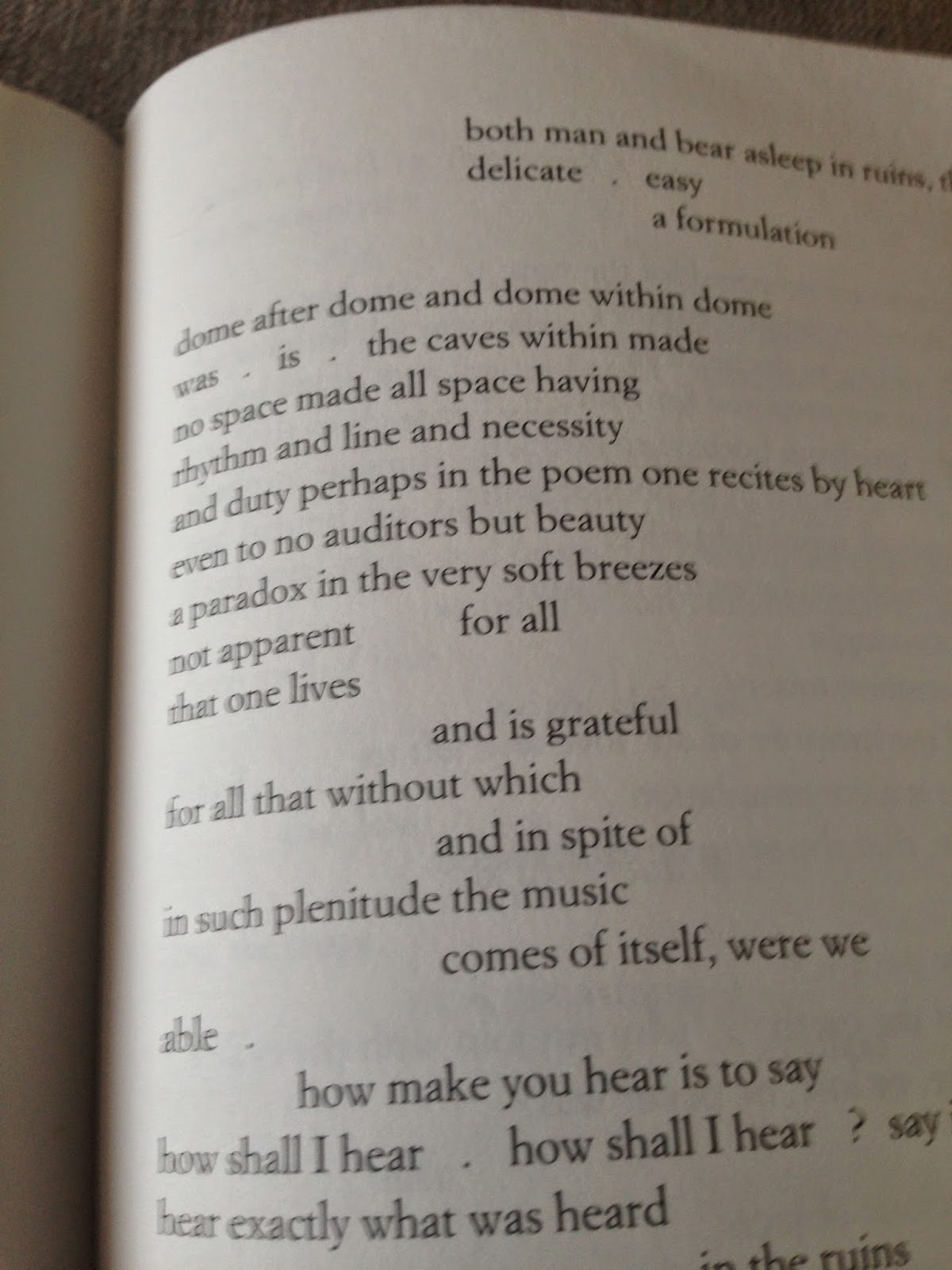
At ten pages, ‘Czargrad’ is more of a Buntingesque ‘sonata’ than a long poem, but it paints on a broad canvas. The ekphrastic dimension of the poem is mirrored by a sense of feeling its way tentatively into the spaces it will inhabit, in ways that register a clear Olsonian influence. Not many poets can claim to have pioneered their own form of punctuation, but in his signature tab-comma-tab Riley shows a sensitivity to questions of timing, pauses and silence. ‘Czargrad’ uses variants on this involving full stops and question marks, and in this passage from section two we find him combining meditations on the space of the poem with questions of church architecture:


The self-correcting movement from ‘was’ to ‘is’ ushers us into the continuous present a theologian might compare to the ‘parousia’, or messianic presence. The paradox of a poem recited without an audience – something ‘not apparent for all’ – suggests something hermetic afoot before the enjambment of ‘for all/that one lives’. Our enjoyment of beauty is set up in conflict with the fact of being alive, in the style of a certain Keats poem, its Grecian urn perfect and deathless for the good reason that it has never had a pulse. Riley pulls back from too simple a life-art dichotomy, introducing the opposition only to override in the knotty complications of the rest of the sentence I’m quoting. Emil Cioran, that gloomy veteran of a Romanian Orthodox upbringing, was adamant that music suffered a disastrous downgrading between the time of Palestrina and Beethoven, since the former wrote only for God and the latter for humanity; and with his little nervous tics of qualifiers, ‘for all that’, ‘and in spite of’, ‘were we able’, ‘how shall I’, Riley worries away at the possibility of a self-sufficient art born of something beyond us, a music that ‘comes of itself, were we /able’ – an aposiopesis followed by one of those tabs plus full stop. For all its full stop, the sentence ends on something closer to an interrupted than a perfect cadence.

Like a show-pony repeatedly refusing to take a jump, Riley’s unfinished constructions have a stubborn and demented logic (why not simply go round the obstacle instead?). One sticking point here, to return to my remark on ‘extrinsic’ factors for Riley’s neglected status, is his unembarrassed way in passages like this with abstractions. ‘Go in fear of abstractions’, Pound was telling us a century ago, advice as much a part of the critical catechism of clichés today as it was in 1913. We simply don’t like poems that use words like ‘beauty’, ‘necessity’, ‘love’ and ‘truth’ without a blush of shame. For a religious poet to swear off abstractions, however, is less easily done. I’ve noted Riley’s distaste for Larkin, but let me invoke that poet again by way a contrast. Reading the early Riley poems of Ancient and Modern I am struck by any number of similarities to Larkin – the visions of leafy renewal in ‘Ancient and Modern’, the railway carriage meditations of ‘Views of Where One Is’, and the comparison of home and abroad in ‘My God, How Sad Russia Is’. To read early Larkin is to read a poetry punch-drunk with abstractions, and purging itself by way of parody Yeats and parody Auden. By the time we come to mature Larkin, it’s not that abstraction disappears, since some of his best-known lines hinge on abstract nouns (‘Life is first boredom, then fear’), but that it has been reserved for special occasions, with a whiff of something shameful and private about it. Whereas in Riley, abstraction remains in the foreground, the figure and ground of his poetic field.


It’s a happy accident of publishing history, as Ian Brinton has noted in his article ‘John Riley: From Lincoln to Byzantium’, that Riley’s poetry lends itself so well to discussion in terms of the theology of Robert Grosseteste, the mediaeval Bishop of Lincoln who gives his name to Riley’s publisher. Among Grosseteste’s innovations in his writing on optics was an insistence on arguing from particulars to generalisations but then back to particulars. The opening paragraph of ‘Czargrad’ is full of dialogue across these categories. In the quiet of the night Riley tries to gather his memories into ‘a book of hours, meanings, hierarchies’, the devotional image subsuming lived experience into religious formula. Instead, random images pile up – ‘blue /flowers yellow flowers a garden a dog a stick’ – before we shift back to the religious register (‘but God decided differently’), leaving further particulars from the garden ‘strangely unrecognisable’. This to-ing and fro-ing can also be seen in a key word introduced on the poem’s first page: city, alternately with and without a capital c. If the line ‘this garden, prehistoric landscape’ can perform the leap from the everyday to the pre-human, I am going to suggest a similarly ambitious leap is possible from Riley’s Leeds to Constantinople, known in Church Slavonic as ‘Czargrad’ – and also to Augustine’s City of God. Augustine’s long treatise addresses the birth of one imperial structure, the Catholic Church, out of the fall of another. Far from being responsible for the fall of Rome, Augustine argues, Christianity was responsible for Rome’s success all along. With the fall of Constantinople in 1453, a strain of Orthodox thought argued that Russia could become the site of a ‘third Rome’, as the destiny of Christendom passed to the Eastern Church. Could Riley be smuggling Leeds onto the list of cities – ‘Jerusalem, Athens, Alexandria, /Vienna, London’ – The Waste Land found central to its vision of world culture yet simultaneously ‘Unreal’? With its strong metropolitan bias, that poem might put up a certain resistance to this – remember the sniggering treatment of its ‘Bradford millionaire’ – but with his studied non-specificity, Riley brings something democratic and ubiquitous to his ‘City of God’.

After one of his spaced juxtapositions in section two (‘the poem . the City’), Riley devotes section three of ‘Czargrad’ to a vision of civilizational collapse and dispersal. This is Riley at his most Eliotian – ‘What are these roots that clutch’ from the opening section of The Waste Land crossed with the translation of Saint-John Perse’s Anabasis. When the poetry breaks free of these themes in the final lines of the section, it does so in a passage that Ian Brinton describes as a ‘clear reference to an icon’, achieving on the ‘still white page’:


Just before these lines, Riley speaks of the ‘avoidance of error’. The sense of kinetic effort to advance from ‘error’ to ‘love’ is highly Poundian, I find. Riley’s friend John Freeman wrote to him that this passage reminded him of Canto 79, but there is a clear echo too of Canto 116 (‘Tho’ my errors and wrecks lie all about me (…) /If love be not in the house there is nothing.’

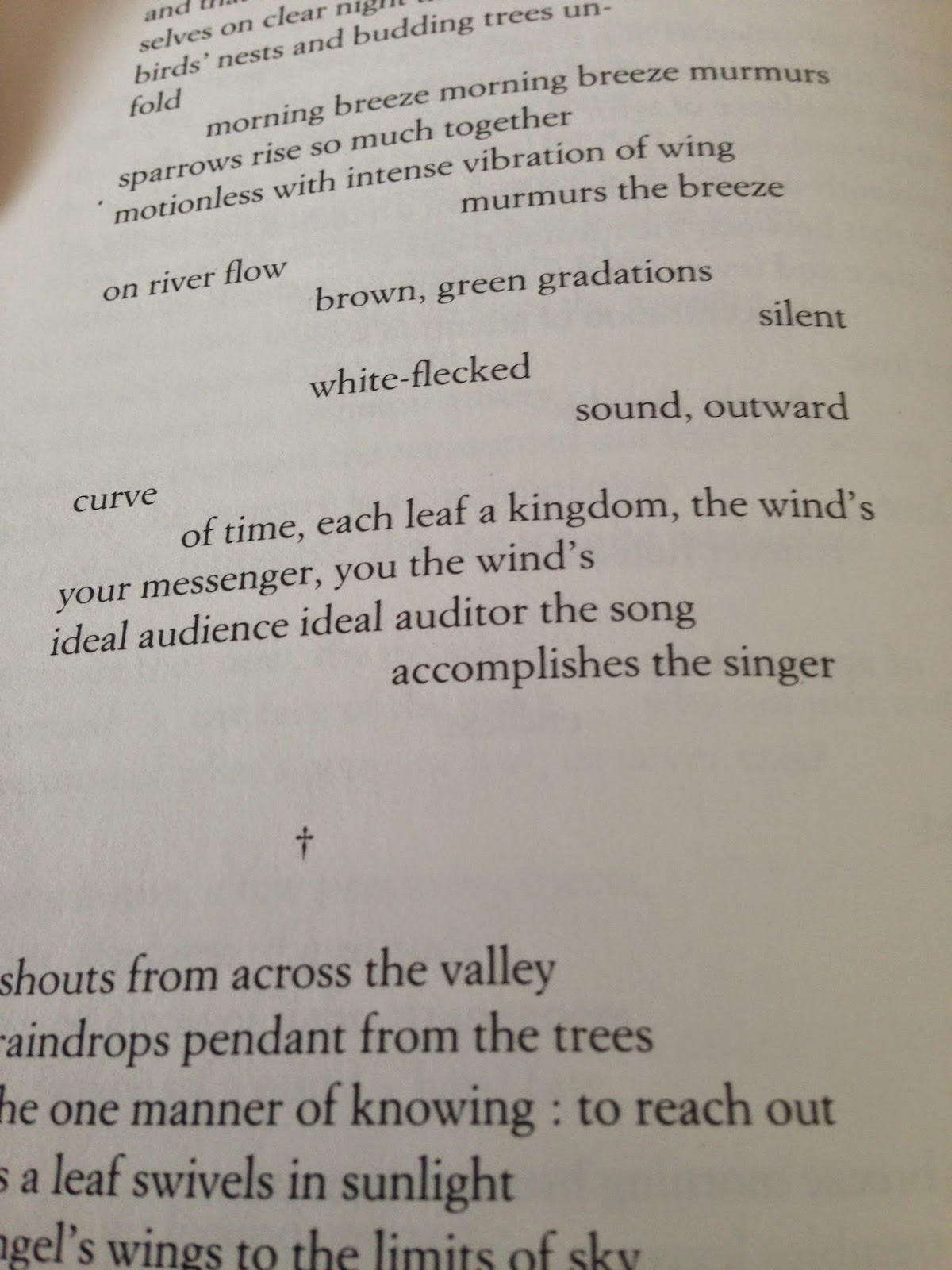
The elderly Pound also saw salvation in terms of a light-bearing icon (‘A little light, like a rushlight /to lead back to splendour’), and like the Drafts and Fragments ‘Czargrad’ captures its moments of grace and illumination in quick and almost casual brush-strokes. I have compared ‘Czargrad’ to a Bunting ‘sonata’, and Riley shares with Bunting a sense of the poem as journey. Section three finds us at sea, immersing us in a flux of sensation that gifts the poem an impersonal momentum:


‘A strong song tows /us’, as Bunting writes at the end of Briggflatts. In section two we had a poem ‘with no auditors’; here song creates its own singer and audience. It is an epiphanic moment, to borrow an overworked term. Riley’s illuminations do not ration themselves to grottoes in hillside churches, but do their work en plein air. The quality of the poem’s engagement with the natural world is worth stressing, and here I might return to Bishop Grosseteste and his theories of matter and substance. For Aristotle, matter falls below substance. Dogs and cats share the matter of creation but are not the same thing. With substance, the whole is prior to the parts: its constituent matter will make it black, white or a ginger, but an unborn cat will be a cat and not anything else. As Ian Brinton writes:

For Grosseteste matter was not pure potency, as it was for Aristotle, but possessed in its own right a certain minimal reality. Thus Grosseteste spoke of matter as a substance: form actualising matter.

Here Grosseteste echoes the work of the ninth-century Scotus Eriugena, whose theology comes as close as Christianity ever does to pantheism, identifying God with nature. Brinton’s phrase ‘form actualising matter’ epitomizes the visual transformations we find in ‘Czargrad’. The encounter with the natural world enters a multi-layered dialogue between known and unknown. When a stream overflows its banks, we find a ‘face of waters’:


It’s difficult, at any given point, to work out whether we are dealing with the human or the divine perspective on nature, or both. I have described the halting or apophanic aspect of Riley’s language of prayer, but his use of the capitalized Word here reminds me of Brian Coffey’s ‘Advent’ and ‘The Prayers’, two poems also much exercised by questions of incarnation. The ambivalent perspective is consistent with a misconception about icons corrected by Brinton: ‘we do not look at an icon’, he insists, ‘it looks at us!’ The Christ of Orthodox iconography wears a sterner expression than that of Western religious art, but though he possesses the heavens he covets the earth, to paraphrase Yeats. The sensual particulars of ‘Czargrad’ seem to be both there and not there:


The City is first present, then ruled out as impossible, then reinstated as unsurpassable in its imagined form, while meanwhile its colonnades, prospects and domes are merely there, floating in Riley’s mobile lines like a Christianized stately pleasure dome. Coleridge’s ‘Kubla Khan’ stakes out a threshold between the imagination and impossibility, and the space of Riley’s floating domes aspires to a borderline existence too. The cultural edgeland occupied by Riley’s Christianity, between the superseded west and the non-Christian east, adds a precariousness to his vision of the divine city. In ‘The Statues’, Yeats pinned his hopes to ‘plummet-measured face’ of Greek art as against ‘vague Asiatic immensities’, while leaving us in no doubt of the seductive power of that non-Christian Other. For Riley too, there is a seductive dimension to such close proximity to failure and collapse. In the poem’s closing section, ‘The City’s Walls fail’ (note pregnant pause), but without any great drama and without the mood notably darkening. Instead Riley reaches for the kind of downbeat landscape writing that reminds me of Johannes Bobrowski, or more recently Peter Didsbury, Pauline Stainer or Gillian Allnutt (‘slight stir of air through grasses /curtains sucked in, out, to the breathing of the wind’). The downbeat quality is deliberate, not accidental, I think, a fact only underlined by his dropping of the name ‘Ararat’ into the passage I’m quoting. No context is offered, but the presence of deeper layers of meaning is signalled unmistakably. Mount Ararat turns up in work of pilgrimage (Voyage to Armenia) by a Russian poet close to Riley’s heart, and one he translated with distinction, Osip Mandelstam. The sacred mountain becomes a site of encounter and exchange – ‘arc of hand poised before the other’, as Riley writes. I’ve said that our western sense of Orthodoxy often hinges on its ceremonial aspect, but in its closing lines ‘Czargrad’ produces a rich and beautiful religious vision without any great show of ceremony. The poem has named its realities into incarnate being, and requires no smells, bells or funny hats to make us recognise the richness of its vision:


Thursday, April 16, 2015

Around the Archipelago: Geophany and the Irish Poet


People have morbid fears of the strangest things. For some it’s clowns, but high on my list would be St Patrick’s Day, that primal scene of kitsch-Celtic fakery. Not being much in the habit of pondering my ethnicity, I was nonplussed back in 2003 to find myself in front of a TV camera in North Carolina being quizzed on what the festival meant to me (I was in town for an Irish poetry festival). The short answer, to be honest, was nothing, but I grinned and did my duty. I was aware in doing so of living up to an expectation of me at odds with my self-image, but aware too of how graceless it would have been to launch into a mini-tutorial on poets and the nuances of national self-identification. We are who we are, but we also are – or have a habit of turning into – what others perceive us to be. Many an Irish poet has gone to the States to acquire, not lose, a marketable Irish identity. The fetishizer is no less to blame than the fetishized: as Stephen Owen has written of the concept of world poetry, we need to recognise that ‘this poet from another land and from a different culture is writing in part for us, writing at least in part what he imagines will satisfy us’. It would be disingenuous to pretend otherwise.

In the natural order of things the reader comes to a poem from the outside rather than the inside; the American idea of the Irish poem is one such example of applied externality. But in distancing myself from that, I do not fall back on the privileges of an easy-going intimacy with my native tradition. Thinking further about how we come to the artwork from inside or outside, I am reminded of Dublin’s Hugh Lane Gallery, and a rare chance it offers to invert the usual terms of this relationship. In a small darkened room on the ground floor is Harry Clarke’s stained-glass response to Keats’s ‘The Eve of St Agnes’. With its brilliant reds and blues, the installation surprises us with the ‘fine excess’ Keats proposed as a signal quality of great art. Using acid-etched, double-layered glass, Clarke creates a sense of depth and texture, whether in the sultry delights of Madeline’s bedchamber or the wintry landscapes beyond the castle walls. The display space allows the viewer to stand cocooned inside Keats’s poem, lines from which Clarke includes in the artwork. I was first introduced to the poem at Trinity College, Dublin, but this was not the first time Harry Clarke’s work had given me cause to meditate on the relationship between the artwork, its audience, and its setting. My own natural setting, in so far as I have one, is the jumble of raking beaches, granite mountains and incipient midland plains that make up County Wicklow, on Ireland’s east coast. One less than natural part of the county is the Poulaphouca reservoir, formed by the flooding of 4000 acres of the Liffey valley in the late 1930s. Marooned on a land spit created by this spot of landscape gardening is the village of Valleymount, home to a highly uncharacteristic Irish country church. Its granite pilasters are in the New Mexican style, imported by Wicklow stone-masons who had worked in that state. Inside the church is a series of stained glass windows by Harry Clarke, no less luminous and multi-coloured than ‘The Eve of St Agnes’, and coming as a considerable shock to my teenage cyclist self, out mapping my kingdom. Never had Co. Wicklow seemed so Keatsian.

If landscape, artist and artwork usually fall into concentric circles, with the artist mediating between the other two, my experience with Harry Clarke impressed on me the unstable nature of this hierarchy. Inside and outside can swap places: the young poet writing his first poems may find himself liberated by stepping (literally) into rather out of someone else’s shadow; an English Romantic poem can be as much a part of the make-up of the city of Dublin as a street-lamp or a patriotic monument; and our native landscapes turn out to be no less constructed and artificial than the artworks we place in them, needing these artworks before they assume the true form in which we will know them at last. In the fifteen years since I last lived in Ireland, these are findings I have pondered at length, transplanting my Irish beginnings from one corner of the Britannic archipelago to another, and watching the landscapes of memory blend and cross-breed with those I have found in England and Scotland. Even before I left Ireland, a lot of its road-signs were pointed in the general direction of ‘elsewhere’. In Autumn Journal, with only lightly ironized detachment, Louis MacNeice wrote of the Irish diaspora who ‘slouch around the world with a gesture and a brogue /and a faggot of useless memories’. More recently, Peter Sirr contributed to a feature on postcolonialism in a poetry magazine I used to co-edit by asking, ‘Don’t all Irish poets live abroad?’


The Wanderlust is inculcated early. Unlike its immediate neighbour, Ireland has never had much of an empire. When I was a primary school pupil in Co. Wicklow in the 1970s, however, the backs of my copy-books came decked out in maps of the world placing Ireland centre-stage, radiating arrows to all the countries in which Irish missionaries were saving the souls of unfortunate heathens. These days I’m told the priests in my hometown come from Africa to save the Irish, but if ever there was an Irish empire impervious to the vagaries of history, it is the empire of poetry. And just like my childhood maps of religious conquest, it is an empire with global reach: Paul Muldoon’s New Jersey and Justin Quinn’s Prague are as much fixtures on the Irish poetry map as Michael Longley’s Carrigskeewaun or Vona Groarke’s Longford midlands. ‘The centre cannot hold’, Yeats grumbled in ‘The Second Coming’, but centre and margin have reached an understanding unforetold by Yeats in the contemporary Irish poem. Derek Mahon’s great ‘A Disused Shed in Co. Wexford’ begins ‘Even now there are places where a thought might grow’, before giving as his first two examples ‘Peruvian mines, worked out and abandoned’ and ‘Indian compounds where the wind dances.’ Far-flung locales generate a shiver of disorientation in the reader, but are accommodated easily enough in a globalized paradigm for what the Irish poem is or should be.

Staying with Derek Mahon, a younger version of that poet once described the housing estates of Protestant Belfast as the final frontier for Irish poetry. The comparison with his Peruvian mines is revealing: here is somewhere about as un-Celtic as it gets, but without any compensating exotic mystique, bringing a dissonant and convulsive quality to the Belfast of his ‘Ecclesiastes’ (‘the /dank churches, the empty streets, the shipyard silence, the tied-up swings’). Even to some of his admirers, this side of Mahon’s work is understandable only as a testing ground for the sensitive young aesthete: staying just long enough to work out the place’s incompatibility with art of any kind, the poet flees the scene and ritually disavows it from the safe distance of Dublin or Kinsale. Moving to East Yorkshire in 2000, I had the chance to put a very marginal zone by traditional standards on the Irish poetic map, in the form of the post-industrial grandeur and desolation of Philip Larkin’s Hull. Larkin had spent five years in Belfast in the 1950s, during which he wrote much of The Less Deceived, and which he would later look back on as the happiest period of his writing life, but in going to Hull I was reversing the journey of his ‘The Importance of Elsewhere’, that great hymn to the benefits of cultural displacement (‘Lonely in Ireland, since it was not home, /Strangeness made sense’). There is a poetry of plangent nostalgia for the Irish home-place: this, I decided early on, would have to take its place in the queue behind the Victorian cemeteries, riverside mills and industrial estates that rapidly seeped into my work. I wasn’t the first contemporary Irish poet to have got to Hull: in his ‘East’ Conor O’Callaghan had recruited the town to an anti-heroic tableau of Irish identity and diaspora played out in unremarkable east-coast Irish towns and the North of England, rather than Ireland’s Atlantic West Coast and its preferred exilic reference points of Boston and New York. This poem riled Irish poet Mary O’Malley sufficiently to inspire a rejoinder, ‘The Loose Alexandrines’, in which she accused O’Callaghan of crypto-West Britonism and imagined him calling for ‘No mad women’ and ‘more Larkin, less Yeats, no Plath’, Larkin standing here for a two-for-one deal on gynophobia and the worst kind of conservatism.


Yet here I was living inside O’Callaghan’s poem, getting to grips with the Hullish ‘importance of elsewhere’, but aware at the same time of the Irish dimension to my experience. According to Conor Cruise O’Brien, ‘Irishness is not primarily a question of birth or blood or language; it is the condition of being involved in the Irish situation, and usually of being mauled by it.’ ‘Mauled’ has a pugilistic ring to it, but it is also possible to be mauled by an absence, or failure to connect. I hadn’t gone to England to mutate into a Larkin mini-me. My personal poetic God is Samuel Beckett, and while I’m aware that Beckett the poet is about as famous as Henry James the playwright or Haydn the opera-writer, I had fretted my way through my twenties wondering how to make my poetry more closely resemble the jump-cut collages of his 1935 collection Echo’s Bones and Other Precipitates. Writing about the North of England represents a challenge to traditional views of what the Irish poem is and does, but Beckett was already up to the same thing well before he left home, in the itchy, alienated poems of his Irish youth. The opposition of home and elsewhere is powerfully embedded in Irish writing, but rather than choosing one or the other, Beckett flits promiscuously between Dublin, the West of Ireland, London and Paris, often within the same poem. In a silent borrowing from Rimbaud, he situates his poems in an impossible no-place: ‘Ah the banner /the banner of meat bleeding /on the silk of the seas and the arctic flowers /that do not exist’.


The young Beckett was dismissive of attempts to revive the Irish language, but when one takes the longer historical view some of the Irish poetry closest to his experience of uprooting and exile was done through the medium of Irish. Led by Colmcille, Irish monks produced some of the greatest works of the early mediaeval period in the far-flung monasteries of Iona and Lindisfarne. While Celtic, as a descriptor, is often used as a catch-call to mean ‘anything but English’, it was visions of Celtic Northumberland that inspired Basil Bunting to his masterwork, Briggflatts, with its thistly vowels and visions of Saint Aidan and Saint Cuthbert. In between persuading myself that I was visiting Hull as a latter-day Celtic atheist monk, I became aware through the work of Ian Duhig of the traditional (‘sean-nós’) Irish singer Darach Ó Catháin (1922–1987), who had transplanted his Irish-speaking family to Leeds several decades before me to work on the roads and building sites. Judged the finest of all sean-nós singers by Seán Ó Riada, Ó Catháin was known to his workmates as ‘Dudley Kane’, and does not seem to have integrated successfully. Recounting a meeting with Ó Catháin in a Leeds pub in the company of poet Pearse Hutchison, Robert Welch describes the party being asked to leave by a landlord who did not want ‘any of that Pakistani singing’. What I learn from this is the ability of Irish poetry and song to move between cultures, but in ways that evade stereotypes and official recognition. Keen to dodge the grandiosity of labels, Roy Fisher has described himself as a ‘sub-modernist’, and in his near-invisible way Ó Catháin can be seen as a ‘sub-national’ artist, equally off the radar in his home and host nations.

Bunting’s Celtic North of England is not the only lost kingdom on the map of the archipelago. The early mediaeval period was marked by the formation of the kingdom of Dál Riata, uniting the north-east of Ireland and the south-west of Scotland. During this period, Scots Gaelic and Irish were still the same language, opening channels of communication that continue to resonate today. Finn MacCool and his merry band of Celtic superheroes, the Fianna, were frequent travellers between the two land-masses, and Mad King Sweeney too flitted across the sea as far as the Isle of Eigg. Mediaeval Irish bardic poets are rarely compared to gangsta rappers, but it’s worth making an exception for another export product, Muireadhach Albanach Ó Dálaigh. The ‘Albanach’ in his name means ‘the Scot’, a reference to his flight to Scotland in the thirteenth century after the murder of a tax collector who had disrespected the poet. Distance failed to bring remorse: quite the contrary, as the newly-transplanted Ó Dálaigh wrote a poem gloating over his crime. Deciding in 2012 that Hull wasn’t quite far enough away from everywhere else, I decided to cultivate my own Dalriadic identity and move to Scotland. When Declan Kiberd gave the title Inventing Ireland to a large critical study, he meant to highlight the ways in which Irish identity has been conditioned by being the ‘other’ of neighbouring entities, meaning England; but while the England-Ireland dyad is achingly familiar from academic discourse, I soon discovered how unexpectedly richer the picture became with the addition of Scotland. There was the English-Gaelic divide, but with the addition of the Scots-Nordic dimension too. There was the great modernist poet, Hugh MacDiarmid, who rather than inspiring an army of poets who wanted to be as like him as possible (early Yeats) inspired generations of Scottish poets to stonewall his impossible example. Early on in my engagement with Scotland, I encountered a fairly literal example of ‘stonewalling’ on a pilgrimage to Little Sparta, the hermit kingdom of the artist and ‘avant-gardener’ Ian Hamilton Finlay. Finlay had been a leading light in the Concrete Poetry movement of the 1960s, poems whose challenge to the reading voice he solved by declaring that concrete poetry was a silent poetry, bypassing the need for oral transmission. Relieved to be let off the hook of having to cultivate a Scottish-accented style before I could write about the place, I threw myself into poorly laid-out concrete poems based on place-name puns (‘Le Monach Isle de mon oncle’) and dramatizations of silence (a poem about a ‘?’ standing on my copy of Birds of Scotland).


There are no hills in East Yorkshire, but given the similarity of Aberdeenshire’s granite peaks to those of Co. Wicklow I was aware of unsettling overlaps: was a Gaelically-inflected poem about the Cairngorms a contribution to the Irish or the Scottish landscape-writing tradition? Unexpectedly, my mobile phone-bill helped me find the answer. Almost all the texts I send are to family members living in Ireland, given which my mother worked out how much cheaper it would be for to communicate via an Irish rather than a UK phone. As far as this phone was concerned, I need never have left Co. Wicklow. It struck me that a significant strand of the Irish poetic tradition continues to operate on similar assumptions. The geographical and cultural other enters Irish poetry in so far as it can be fed through Ireland-centric reference points. Routing your poem home to Ireland through a foreign network comes at a higher price. I experienced this tension as a form of stand-off before crowbarring a third element into my dilemma by way of a solution. Like the Irish language, Scots Gaelic is a minority language and one whose continued survival is dependent on government aid. In Scotland, however, the picture is complicated by the presence of another tongue, in a linguistic ménage à trois: Scots, the language of Robert Burns. Feeling the want of local poetic gods to celebrate, I took advantage of six months Robert Fergusson (1750–1774) spent in Aberdeenshire to start writing sonnets in Scots addressed to that great and short-lived poet. The eighteenth-century rhyming weavers of Antrim wrote in something resembling Burns’s Scots, and contemporary Belfast poet (and Edinburgh-resident) Alan Gillis makes witty use of Ulster Scots, but my project had an element of wilful quixotism about it. As far as T. S. Eliot was concerned, in ‘Was There a Scottish Literature?’ (1919), Scots was a dead tradition, a sentimental throwback or two such as Burns or Fergusson aside. Here was my ‘sub-national’ tradition again.

Among the most impressive pieces of literary scholarship published in the last decade is John Kerrigan’s Archipelagic English: Literature, History, and Politics 1603–1707 (Oxford, 2008). In head-spinning detail, Kerrigan traces the patchwork identities from which modern Britain and Ireland were fashioned. The union of 1707 was highly unpopular in Scotland, and many of the Scottish nobles who voted in favour changed their minds shortly afterwards, it seems. Something else I learned about Aberdeenshire was its centrality to the Jacobite Risings of 1715 and 1745 against the House of Hanover. My colleague, the poet Peter Davidson has written evocatively of the relics of Jacobite culture that dot the Aberdeenshire landscape, the forlornly beautiful castles nestled between the North Sea and the mountains. In his collection The Palace of Oblivion, he celebrates this landscape in a national language of Scotland that predates both Scots and Gaelic, Latin.


On one level, this is harmless antiquarianism, you might think, with no obvious relevance to contemporary Irish poetry. But as an incomer to these parts, I drew radical lessons for my own work. When my Aberdeen colleague Patrick Crotty, edited The Penguin Book of Irish Poetry he suggested listing on the cover some of the translators he had recruited, Seamus Heaney, Michael Longley, Paul Muldoon and Kathleen Jamie among them. Penguin objected to the fourth of these, given that Jamie is Scottish, not Irish, and might therefore confuse prospective buyers. Crotty stood his ground, helping to remind readers not just of the international appeal of Irish-language poetry, but the international nature of its composition in the first place. Reviewing a more recent anthology of Irish writing, Maurice Riordan’s, The Finest Music: Early Irish Lyrics, I found myself comparing the work of its anonymous Irish scribes to the Objectivists. Here were the ‘diamond absolutes’ of Heaney’s ‘Exposure’, and the scalpel-like precision of Niedecker and Oppen’s lyrics. Reading the line ‘And ancient Ireland knew it all’ in Yeats’s ‘Under Ben Bulben’ it’s easy to diagnose a case of geriatric belly-aching, and though even Yeats might draw the line at crediting Columcille with a prophetic vision of An ‘Objectivists’ Anthology, the things that ‘ancient Ireland knew’ were not limited to Ireland, nor are its lesson confined to Irish poets writing the Irish poem in Ireland.

When asked in 1915 what he was fighting for, Edward Thomas knelt and picked up a handful of English dirt: ‘Literally, for this’, he answered. As someone blessed or cursed with a geographically over-active imagination, I have always felt my writing lives or dies by its engagement with the literal ‘this’ of what the English-born, Connemara-based cartographer Tim Robinson calls ‘geophany’, the ‘visible manifestation of the earth’. The only problem is the entirely accidental nature for me of what the ‘this’ is at any given moment. Having got my Scots sonnets off my chest, I began to cast around for another submerged local culture to engage with (perhaps the Shetland islands, and their lost ‘Norn’ language…). And then there’s the question of form. While Paul Muldoon remains among the most ingenious rhymers in Anglophone poetry, it feels like a long time since a younger Irish poet sprang to prominence for audacious formal experiments. I’ve mentioned sonnets and concrete poetry, but steadfastly refuse to develop an identity crisis over my habit of writing both. Peter McDonald has objected to prefixing the word ‘form’ with the verb ‘to use’: does one ‘use’ the oxygen one breathes? Writing the best sonnet or concrete poem we can is much more important than any tribal identity based on choosing one over the other.


In a wonderful letter of 1864 to A. W. M. Baillie, Gerard Manley Hopkins outlined his thoughts on ‘Parnassian’ poetry. The Parnassian is not exactly bad poetry, but poetry which is ‘too characteristic of itself, too so-and-so-all-over-ish, to be quite inspiration’. Mount Parnassus may not be such a wise aspiration for the poet after all. Had he been a Russian formalist, Hopkins could have preached the virtues of ostranenie, of defamiliarizing as a route to making it new. In ‘Spelt from Sibyl’s Leaves’, which dates from his Irish miserable exile two decades later, Hopkins wrote one of the strangest Irish landscape poems ever, using a palette every bit as arresting as Harry Clarke’s stained-glass windows. Yet, but for this spiky proto-modernist, his great admirer Seamus Heaney might never have found his way to the apparently rootsier style in which he celebrates the landscapes of Bellaghy, Toome and Anahorish. Where in all this is the true ground and form of the Irish poem? We might say of it, as Wallace Stevens did of the singer in ‘The Idea of Order at Key West’, that ‘There never was a world for her /Except the one she sang and, singing, made.’ I can’t know for certain, but I would hope the Irish poem is as happy being written in Scots about Aberdeenshire as it is by a Victorian English Jesuit about the Dublin skyline. I’ve quoted Peter Sirr’s observation about Irish poets all living abroad. To which I would now add: yes, including the ones who live at home, wherever that may be.

Monday, April 13, 2015

In Answer to the Question, Whether I Have Anything to Say on Water Charges in Ireland


I am against the water charges in Ireland. Good for anyone who doesn’t fancy paying them. I haven’t written any poems on this subject because it doesn’t spark my imagination. I don’t live in Ireland and can’t name more than one or two serving Irish government ministers. I can’t force into existence a poem that doesn’t want to be born. I’m sure this represents a political cop-out on my part, but not one I have any real will to put right. If I did fancy mounting a case for my defence I could point to some poems I’ve written inspired by the Scottish independence referendum which contain a fair deal of bile directed at the No campaign, Scottish Labour, etc. I say ‘If’, because I resist any impulse to defend my writing on political grounds. I would consider my politics as well to the left of the Guardian but yes, I am the kind of leftist who expresses his Marxism more by reading Adorno on Schoenberg than by going on demonstrations. Just now I find myself wanting to write poems, not about contemporary politics at all but mediaeval Orkney and Olivier Messiaen’s organ music. I think poetry is, at base, an indefensible art: it is inherently irresponsible and should not have to apologise for this fact. My understanding of art has been comprehensively shaped by Marxist theory, but I follow Marx in his belief that the development of art and the development of society are not the same thing: parallel, overlapping, quarrelsomely divergent, mutually-shadowing perhaps, but not the same thing.

Art is a sphere of freedom and possibility. It offers freedom *to* and freedom *from*: I am free to write about political subjects that move me, but also free from any compulsion to write on prescribed topics, on the immediate, on today’s headlines. I can experience the reality of art as easily, and perhaps more easily, by writing about the middle ages than by writing about water charges in Ireland. But that’s just me. I place no one else under my personal prescriptions. Many poets have chosen the ‘freedom from’ model, and not just poets normally thought of as writing at an oblique angle to the politics of their day. There are no Emily Dickinson poems directly about slavery and abolitionism, despite her living through the Civil War. But equally James Clarence Mangan lived through the famine of the 1840s, writing as the figurehead of nationalist Young Ireland, and look at his poems: all that anger and despair channelled into bizarre games with fake translations and personae. Why? Was this a failure of political nerve? Why couldn’t he just say it out straight? Because, for me, this is what happens when art and politics collide. The outcome cannot be predicted or prescribed. If it could, it wouldn’t be art.

But take more politically plain-speaking poets, if these examples seem evasive. Try reading Neruda, Brecht or MacDiarmid ‘straight’ as political poets defending the indefensible, which they frequently did, and you get a terrible, just terrible Stalinist mess. (And that’s just the left: as for Eliot or Pound…) Enjoying their work doesn’t require neutering their politics, but seeing the cages of politics, tyranny, and ideology for what they are, and art for what it is too, rattling its chains in the corner. I love Brecht’s poetry, but when I read him I see art and politics rub against each other more in the style of a car-crash than a mating dance, and a car-crash that numbers him among its victims as much as anyone else. It’s still exhilarating though, and my enthusiasm for both him and leftist politics emerges from the experience unscathed. I think a useful test for anyone interested in poetry and politics is to choose a writer whose politics you find repellent and ask yourself why, nevertheless, their poetry is so good. A certain Irish poet celebrating his 150th anniversary this year does the trick nicely, I find. No social democrat he (‘What’s equality? Muck in the yard.’) ‘Heart-mysteries there’, as he also said. A better world is certainly possible, and better poetry too. On which note, I propose to adjourn for a rereading of Adorno’s ‘Reconciliation Under Duress’.

Sunday, April 05, 2015

‘His Words Are Not His Words’: Generational Succession in Contemporary British Poetry


Dreaming of peace in Northern Ireland, Seamus Heaney famously looked forward to a time when ‘hope’ and ‘history’ might rhyme. It would be an enviable problem, as political problems go, if all that stood between Northern Ireland and post-Troubles utopia was a question of poetic technique. Writing in the 1890s, however, W. B. Yeats nicely encapsulated the way in which one’s posterity might depend, for reasons beyond one’s personal control, on matters of poetic form and rhyme. ‘Nor may I less be counted one /With Davis, Mangan, Ferguson’, he wrote in ‘To Ireland in the Coming Times’. Two lines of iambic tetrameter, the first a pious aspiration, the second a list of three names – Thomas Davis, James Clarence Mangan, Samuel Ferguson – into whose company Yeats has now insinuated himself. There are only so many poets’ names one can squeeze into two short lines, after all, so other aspirants to the canonical ground: be warned. Even today, Yeats’s coding of proleptic literary history into poetic form is imbued with a strong authority. Among the most exciting things to have happened to the Irish nineteenth century in recent times has been the rediscovery of the work of James Henry, a mordantly atheist poet and link in the chain from Swift to Beckett. How might Yeats’s line be rewritten to accommodate him? ‘A member of the poets’ club, though honorary, /With Davis, Mangan, Ferguson and Henry’? But that’s a pentameter. The poem’s ‘write-protect’ labels jealously guard the canonical bounds that Yeats proposes.

Introducing his Oxford Book of Modern Verse in 1936, Yeats gives a majestic lesson in surveying the poetic generations that had come and gone since those salad days in the Cheshire Cheese almost half a century previously, site of his celebrated quip that ‘None of us can say who will succeed, or even who has or has not talent. The only thing certain about us is that we are too many.’ If there was a single dominant trait in Yeats’s character, his biographer Roy Foster has written, it is a sense of how things would look to posterity, and even when recounting anecdotes of his youth, Yeats excels at impressing on the reader that there is only going to be one long-term winner in his tales of contemporaries laid low by drink, drugs, syphilis or failure, and it won’t be Swinburne, Lionel Johnson or Oscar Wilde. Yet Yeats has reserved a peculiar glory for these casualties of rhyme, the 90s poets ‘unreconciled in their metaphysical pain’, to adapt a phrase of Derek Mahon’s. If they have not survived into the ‘filthy modern tide’, as Yeats would call it in ‘The Statues’, it is not because they lacked Yeats’s survival instinct; on the contrary, it is because they were too good for it:
Then in 1900 everybody got down off his stilts; henceforth nobody drank absinthe with his black coffee; nobody went mad; nobody committed suicide; nobody joined the Catholic church; or if they did I have forgotten.

It is not that Yeats is directly commending these activities to anyone in 1936, though his Steiner Clinic adventures with monkey glands match anything on that list of eccentricities; rather, he is recruiting his contemporaries into a mythology that will transform the stock-market of literary opinionation into something more like a Dantesque final judgement. Writing of Baudelaire six years before, T. S. Eliot had imagined the French poet walking the streets of Paris convinced of his superiority to statesmen and thieves since, unlike them, he was man enough to be damned. If damnation is what awaits Lionel Johnson & co., it is unexpectedly softened by the chance to play a walk-on part in Yeats’s mythopoeia, as Johnson does in his great elegy ‘In Memory of Major Robert Gregory’. The ‘falling’ in the first line I’m about to quote is a reference to the story, repeated by Ezra Pound, of Johnson’s death in a fall from a bar-stool:

much falling he
Brooded upon sanctity
Till all his Greek and Latin learning seemed
A long blast upon the horn that brought
A little nearer to his thought
A measureless consummation that he dreamed.

In Yeats’s well-appointed mausoleum, the poet’s shortcomings come to seem irrelevant. Lowly though his sphere might be, it harmonizes strangely with Yeats’s lofty love-choir. Like Moses, he glimpses but does not enter the promised land, a promised land which only the most obtuse of readers will have failed to recognise as Yeats’s work and the dead man’s emblematic role therein. In celebrating the dead, we cannot help appropriating them too; and if Yeats does this with Johnson, he is already doing it to a far greater degree with the subject of the poem, Robert Gregory, no friend of the poet’s in life. While artistic appropriation came naturally to Yeats, the vice is not unique to the Irish poet. Milton’s ‘Lycidas’ approaches its subject, Edward King, with such heartbreak that it dematerializes him without a second thought into a classical convention. So strongly in charge is Yeats, in his elegy, that he can end by giving up on his poem without any loss of authority. He had thought of celebrating the dead man’s achievements in greater detail, he tells us, ‘but a thought /of that late death took all my heart for speech.’ The failure of elegy becomes its moment of triumph.


In saying this I am setting up a tension between artifice and authenticity: a tension, as we shall see, with much to tell us on the nature of poetic generations. My elegiac point of entry is hardly accidental though. It is a peculiar vice of the contemporary age to treat elegy as a last bulwark of authentic feeling against the trickeries of the post-modern age (‘Post-this, post-that, post-the-other, yet in the end /Not past a thing’, as Seamus Heaney begins his poem on first looking into Ted Hughes’s Birthday Letters). Can it be coincidence that volumes of elegy have proved so irresistible to prize-giving committees? It would take some audacity for a contemporary poet to assert him or herself with the same authority claimed by Yeats, but looking back from the third vendange of poetic New Generations we now see the cheery blue skies of the first such promotion in 1994 through a greyer elegiac filter. I’m referring to the death of Michael Donaghy, a central part of the first New Gen, and whose death in 2004 prompted a heartbroken downpour of poetic lamentations. Among these are the haunted poems of his New Gen confrère Don Paterson, who has also memorialized Donaghy in the prose commentaries of Smith. Death, whatever else it is, is an artistic opportunity. Our readerly expectations of elegiac sincerity were a prime opportunity for Donaghy, in his time, as a lifelong believer in ludic fakery. ‘An Excuse’ begins with the confessional feint: ‘“My father’s sudden death has shocked us all.” /Even me, and I’ve just made it up.’ Paterson illustrates his essay on confessionalism in Smith with another Donaghy poem ‘Acts of Contrition’. The poem is in three stanzas, of six, six and four lines, and moves from a memory of the confessional box in the poet’s youth to a suicide attempt and a police incident room. In each case, the poem handles without making fully available some moment of personal crisis. ‘I’m working on my confessional tone’, says the young confession-goer, hinting that the element of performance is all; ‘Here’s where I choose between mea culpa /and Why the hell should I tell you?’, says the suicidal poet; and ‘I could be anyone you want me to be’, says the poet under interrogation by the police.

The verb ‘interrogate’ is a favourite of the modern critical idiom: we interrogate poems for what they have to say about race, sex and gender, roughing them up only ever so slightly in the process, before releasing them back into the community. Are we right to hear a small cry of distress behind Donaghy’s boast that he can be anyone we want him to be? It’s less the being of X, Y or Z that is the problem than the element of coerced performance, and which should perhaps qualify our delight in his thespian bravado. While ‘An Excuse’ trades on a dramatic reversal, cancelling the confession it initially proffers, the cancellation as much as the confession is heavily conditioned by a quality of assumed intimacy, the quality of bidding or address that Natalie Pollard has studied as a defining aspect of recent British poetry. As showman, the poet is aware of the high-jinks expected of him, and obliges with the requisite party piece. This does not detract from the essential seriousness, which is to say ludic seriousness, of the exercise. In his commentary on ‘Acts of Contrition’, Paterson lets us in on a little secret, in the form of a youthful suicide attempt by the poet: ‘The black private “joke” here is that Donaghy really is writing confessional poetry, and is double-bluffing [...] He doesn’t, however, consider this an important enough detail to explicitly ‘share’ with us.’ The conversations of elegy, authentic or bogus, are paradigms for the conversations that constitute poetic generations.

Like many beloved national institutions, Michael Donaghy was an import, and if ‘An Excuse’ trades on fake family history, the young Donaghy’s move to Britain was heavily conditioned by the trouble he was having within the American poetry family in the 1980s. It is a story he told often, of the takeover of literary theory, the death of the author (Michael Donaghy was once thrown out of a seminar in Chicago by Paul de Man), and the usurpation of the American lyric line – the line of Bishop, Wilbur and Hecht – by the tuneless spambots of Language poetry. While Donaghy wore a largely benign public persona on other topics, the avant-garde brought him out in ferocious spasms of denunciation. Experimental writing, as Paterson summarizes Donaghy’s objections, is all ‘intertextuality [...] but no text’, ‘funless harm’, a ‘suicide note’, ‘meretricious novelty, endlessly repeated’. Its failure are failures of presence, voice, continuity and succession, and where British poetry was concerned Donaghy (though no academic himself) was fearful of an academic takeover of British poetry too by the people he called the ‘ampersands’, the rich music of the British lyric replaced by Prynnite white noise. Since I mention white noise, though, this topic comes up in the Donaghy poem ‘Disquietude’, which conveniently for my purposes telescopes the themes of voice, silence, paranoia, sex, succession and sterility into twenty lines. The speaker is lying in bed beside his partner, unable to sleep. He conducts an interior monologue, but one in which he explores his distrust of the voice, his own or the human voice in general. ‘Would you know if our phone was tapped?’, he asks, and describes the tell-tale sounds of clicking on the line suggesting someone is listening in. Then the poem takes a sexual turn, as he describes stashing a tape recorder under the couple’s bed ‘when we were younger and hornier’. All the mic picked up, however, was ‘wheezing springs’; ‘It would be like listening to strangers now’, he concedes, in a moment reminiscent of Beckett’s Krapp’s Last Tape, that masterly statement of the tangling and mangling of voice and self in the technologies of their preservation. Distorted and incomprehensible though this static is, it begins to seep into the present-tense of the poem, with its own imperious demands:

Sometimes, when I wake beside you in the night
and the door of sleep slams shut and locks behind me,
I hear it creep up out of silence, a brash hush,
a crowded emptiness, the static of the spheres.

It’s like a tap left on. But it’s my own warm blood,
the flood that’s washing all the names away,
of schoolmates, kings, the principal export of somewhere,
and all the sounds as well – a lullaby, a child’s voice –
my own warm blood that must be blessed.

No recording devices are allowed in this hall.
The lights dim, and onstage they’re coughing,
turning pages, giving the score their indivisible attentions,
getting settled for the next movement,
which features no one and is silent.

In a striking reversal, the agent of disturbance is not just the eternal silence of those infinite spaces that so terrified Pascal, not just something cosmically out there but an anxious enemy within: the poet’s ‘warm blood’. As Larkin’s ‘Talking in Bed’ showed, bed-based poems have a knack of discovering disquietude in even this most comfortable setting, and in his final stanza Donaghy turns his anxiety back on the concept of voice. I used the phrase ‘write-protect label’ earlier, and here Donaghy employs a quasi-legal injunction in an attempt to reassert vocal control: ‘no recording devices are allowed in this hall’. By way of an aside, I am reminded here of an incident during a poetry reading I attended when the poet mistook a man fiddling with his hearing aid for someone trying to record him, and walked over and asked him to stop. The market for bootlegged poetry readings – or even lectures about poetry – is, I imagine, rather small, but the intimacy of address we enjoy is all part of the aura on these occasions. Speaking of intimacy, Donaghy died before he had a chance to see the 2006 German film The Lives of Others, in which a Stasi agent in the attic is listening in on every moment in the life, including the sex life, of a couple in the apartment below. At one key moment, a conversation is held to test whether the agent is fact there. When the response that would accompany an eavesdropping agent fails to materialize the central character mistakenly decides he is not under surveillance, an assumption with tragic consequences. In ‘Disquietude’, Donaghy casts himself as both dissident and Stasi agent. The intimacies of the private, i.e. lyric voice are subject to hostile surveillance from the forces of white noise, whose transcription of these precious intimacies is a form of bureaucratic gibberish. Yet this is a poem of intense paranoia too, recognising that if there is no actual Stasi agent (or Cambridge poet) in the attic, the speaker is more than capable of performing this function for himself. He struggles to reassert control over his voice, but such is his failure to recognise himself in his own words anymore (shades of Beckett’s Krapp again) that only silence remains.


As chance would have it, Donaghy has another poem on John Cage in an anechoic chamber in Harvard University, in which he hoped to experience complete silence. Like the pursuit of absolute zero on the temperature scale, absolute silence proves elusive, as with the removal of extraneous noise the composer is left with the thumping sound in his ears of his own heartbeat. The resulting musical piece, 4’33”, reflects this impossibility: in performance it is anything but silent, as the restive audience begins to cough and fumble in its seats. We may scoff at this avant-garde prank, but when we play the recording back the inglorious noise we are listening to is our own. The phrase School of Quietude was coined by Ron Silliman as a pejorative shorthand for the conventional lyric, born of contemplative stillness, but for Michael Donaghy no less than John Cage before him, the silence of the lyric self was a zone of treachery and disquietude. The next movement, or poem we might father on posterity miscarries: it ‘features no one and is silent’. This counter-narrative, in which the natural succession of voice to voice from one generation to the next is replaced by silence, manages to gatecrash one of Donaghy’s warmest poems, ‘Haunts’. The poem is addressed to his son, and begins ‘Don’t be afraid, old son, it’s only me’, but is an exercise in acousmatic disembodiment, an echo the addressee will recognise years from now much as he might remember his father in the ‘margin of a book you can’t throw out’. The words of the poem seem to travel from father to son, but originate – by way of a Möbius strip-like circuit – with the son. Their source is:

the way that child you were would cry out
waking in the dark, and when you spoke
in no child’s voice but out of radio silence,
the hall clock ticking like a radar blip,
a bottle breaking faintly streets away,
you said, as I say now, Don’t be afraid.

So who exactly is comforting who? Each is comforting the other simultaneously, on the basis of a reciprocal but ultimately groundless refrain spoken out of that ‘radio silence’.

For such a powerful begetter of New Gen and post-New Gen poetry, Donaghy’s vision of generational succession is curiously bleak, or if not bleak, one in which the voices leading the dialogue of present and past – and future – break out in the strangest places, as though one found oneself poetically apostrophised by a car-park entrance barrier or Tesco self-service checkout. To my earlier opposition of artifice and authenticity I would now like to add a second, that of address and voice-dispersal, the scattering of voice in unexpected ways to unexpected heirs. It is a common misconception, where poetic generations are concerned, that one hands over to the next in the style of relay-racers, their elders’ words of encouragement ringing in their ears as the youngsters speed away. As T. S. Eliot wrote in ‘Tradition and the Individual Talent’:

If the only form of tradition, of handing down, consisted in following the ways of the immediate generation before us in a blind or timid adherence to its successes, ‘tradition’ should positively be discouraged.

Most poets would bridle at the idea of writing out of ‘blind or timid adherence’ to anything, but the ‘handing down’ or handing over present in the word tradition can have other, less comfortable meanings too. Tradition is also ‘the act of delivering into the hands of another’, as in a prisoner swap, and the connecting lines from generation to generation can swerve in unexpected directions. A map of poetic influence rather than of croneydom would look strikingly different from the flow-charts one sometimes encounter in the wake of prize-giving scandals, showing all the who-knows-who connections of the poetry world. [SLIDE] The Russian Formalist Viktor Shklovsky proposed a ‘knight’s move’ theory of literary history, in which decisive steps are taken in an oblique or diagonal form, my variant on which would be the crazy uncle scheme, which I will confess to deriving from the works of Flann O’Brien, an author whose world is strangely lacking in father-son relationships but full of cranky uncles. I could name Flann O’Brien as one such New Gen crazy uncle, in his influence on Ian Duhig’s Celtic-tinged, anarchic wordplay. Others would include Weldon Kees for Simon Armitage and Michael Hofmann, Raymond Roussel for Mark Ford, Emil Cioran for Don Paterson, and McGonagall for W. N. Herbert.


I’m going to interrupt myself right there, before anyone else does it for me, and point to a glaring problem with this theory. As theories of influence go, it is pleasantly lacking in the testosterone-addled tauromachia of Harold Bloom’s Anxiety of Influence, but even as it dismisses patrilinearity it avuncularly smuggles it straight back in. Let me now propose an alternative mode of influence transmission by way of a poem by Kathleen Jamie, ‘Arraheids’. Where are all the crazy aunts or grandmothers in Shklovskian theory? Answer, in an Edinburgh museum cabinet:

See thon raws o flint arraheids
in oor gret museums o antiquities
awful grand in Embro –
Dae’ye near’n daur wunner at wur histrie?
Weel then, Bewaur!
The museums of Scotland are wrang.
They urnae arraheids
but a show o grannies’ tongues,
the hard tongues o grannies
aa deid an gaun
back to thur peat and burns,
but for thur sherp
chert tongues, that lee
fur generations in the land
like wicked cherms, that lee
aa douce in the glessy cases in the gloom
o oor museums, an
they arenae lettin oan. But if you daur
sorn aboot an fancy
the vanished hunter, the wise deer runnin on;
wheesht... an you’ll hear them,
fur they cannae keep fae muttering
ye arenae here tae wonder,
whae dae ye think ye ur?

Jamie’s poem works to recover the silenced voices of history; and, more than most, the modern Scottish tradition was one in dire need of feminist recalibration. The female voice is first identified with nature, then with the folk tradition – identifications that serve to keep it short of fully-acknowledged personhood. The salty twist to Jamie’s poem is that the disapproving tongue, once we do recover its message, is telling the poet to shut up. The duty to speak not just of, but for the absent is one that stalks the historical imagination, while placing the salvage artist in a difficult position. How to give a voice to the past without first establishing one’s credentials to speak on its behalf? How can we be sure the past is so reciprocally keen to speak to us, and on our terms? Of the 1994 New Generation poets, Mick Imlah, David Dabydeen, and Lavinia Greenlaw have written with sensitive understanding of the past, whether the Scottish nineteenth century, the tragedies of colonial Guyana, or love in the age of Geoffrey Chaucer, but Jamie’s poem highlights the economies of scale to be negotiated before the voice of history and the voice of the lyric ‘I’ can be reconciled, if they can. Jamie has already accommodated the voice of history by writing in Scots, a language whose international credentials she has done much to restore, but the internalized self-censorship of the past, and of its silenced victims, becomes not just the message but the medium of the poem too.

Loss and silencing are the other side of generational canon-formation. The stunning reappearance of Rosemary Tonks’s work, just like that of Lynette Roberts before her, reminds us of what we don’t talk about when we talk about generations, or visible poetic generations at least, and of our duty to think of poetic eras ‘complete with missing parts’, in Beckett’s phrase. The question of gender brings a particular edge to this discussion, as metaphors of patrilinear succession are embedded deeper than we may care to acknowledge in critical language. In an essay on the fate of women poets in the Irish canon, Moynagh Sullivan has pointed to the controlling influence, as she sees it, of metaphors of male lineage. Examining an overview by Patrick Crotty of the post-Revivalist era in Irish poetry, Sullivan alleges a difference between the male and female poets who fall by the wayside in Crotty’s account as minor versifiers. When women poets such as Ethna Carbery or Alice Milligan are found wanting it is because they are ‘predictable propagandists’, fitting all too easily into a predetermined narrative of their essential smallness. When male poets fall short of greatness, and are ruled ‘anaemic’, ‘vatic’, or ‘lifeless’, ‘they still manage to become “memorable” in some way because of a biographical detail, anomalous subject matter, some striking lines, or because they anticipate somebody better.’ While I don’t find, in Crotty’s narrative of literary history, the same overweening male narrative that Sullivan does, this argument highlights the ways in which canonical status can seem a matter of manifest destiny. In the same way that Pip, in Great Expectations – unlike his family – already speaks standard English before becoming the beneficiary of Magwitch’s patronage, different kinds of poet are marked out for different fates. The story of Rosemary Tonks’s disappearance is sensational and compelling, but also bears all the contours of a madwoman in the annexe story, in Edna Longley’s words for the volumes of the Field Day Anthology devoted to women’s writing, commissioned after the realization of the male-heavy flaws of that project in its original form. When F. R. Leavis included Gerard Manley Hopkins (first published in 1918) in New Bearings in English Poetry, he was keener to promote that poet as a contemporary of Pound and Eliot than as any kind of Victorian, but as well as rediscovering Tonks as our contemporary we need to revise our narratives of the 1960s, and descriptions such as Morrison and Motion’s in their Penguin Anthology of Contemporary British Poetry that this was a period of ‘lethargy’, when ‘very little seemed to be happening.’ There are some poets whose first name might as well be ‘the underrated’ – Roy Fisher gets a lot of comic mileage out of this in interviews – but the ‘overlooked’ Rosemary Tonks will only get us so far, versus the Rosemary Tonks whose retrospective significance should be a revisionist account of the 60s and 70s, if only in answer to the voice of Motion/Morrison telling those sceptical of their version of literary history ‘Ye arenae here tae wonder, /whae dae ye think ye ur?


Tonks the outsider is a healthy reminder of the limits of generational self-awareness, but a further complicating factor, in bringing generations into focus, is their ability to reinvent themselves from within. Like Don Paterson, Kathleen Jamie has recently been the subject of an academic essay collection, and also like Paterson her work has been found to divide sharply into early and more recent stages. Only ten years ago, I hazard, a book on Jamie would have stressed the elements of woman and nationhood in her work, themes almost completely eclipsed in Rachel Falconer’s essay collection by ecopoetic responses to Jizzen, The Tree House and The Overhaul, as well as the prose writings of Findings and Sightlines. (Where Paterson is concerned, critics once keen to recruit him, by way of his class politics, as a successor to Tony Harrison or the Douglas Dunn of Barbarians, have promoted him to a more free-floating formalism instead.) It’s no shortcoming for a poet to sustain different or even contradictory styles of reading, and there is no certainty that her ecopoetic incarnation is where Jamie will come to rest. Peter Mackay ends his essay on Jamie on a note of caution: ‘This is not poetry as the song of the earth, or of a revelation of dwelling, but as a stymieing and troubling of communication [...] an art of non-communication, a resistance, a making strange.’

Ecocritics may, for the most part, like their poets to ‘dwell’ securely in prescribed zones of environmental interest, but writers can be difficult to pin down on their own patch. I think again of Yeats, a writer with the somewhat scandalous habit of rewriting extensively the poems of his youth: often, the Yeats poem of the 1880s you find yourself admiring for its maturity beyond the author’s years, turns out on closer inspection to have revised almost beyond recognition by the Yeats of the 1930s. Christopher Ricks, a noted Yeats sceptic, goes so far in his Oxford Book of English Verse as to publish two versions of ‘The Sorrow of Love’ as an implied small protest against this habit. Yeats had a stock answer ready for his sceptics, however: ‘The friends that have it I do wrong /Whenever I remake a song, /Should know what issue is at stake: /It is myself that I remake.’

The remaking of the self involves a certain sloughing off of dead skin, and if we return to Peter Forbes’s introduction to the New Gen issue of Poetry Review in 1994 much is made of the poets’ rejection of what he calls the ‘Oxbridge hegemony’ and the ‘lost empire’ of its systems of patronage, last seen disappearing over the hill with the Motion/Morrison Penguin Book and Ian Hamilton’s Oxford Companion to Twentieth-Century Poetry. While the school sports-day exhibitionism of Craig Raine’s Martian period (‘the dustbins bulge like vol-au-vents’) makes an easy target, the generation in Forbes’s cross-hairs also produced Christopher Reid’s Katerina Brac, a book that rejects patrilinear national traditions with a vengeance. Simultaneously a product of, and a sly critique of the Eastern European translation boom of the 1980s, Katerina Brac practises an arch voice-dispersal all the more convincing for leaving the basic coordinates of its heroine’s identity undefined, just as, contemporaneously, E. A. Markham was finding it liberating to exchange the expectations of Montserratian authenticity, for the freedom to personify – persona-fy – the white, Welsh feminist he called ‘Sally Goodman’. Here is Katerina Brac addressing the future, which she finds unreal in comparison to the here and now, even though the present is represented by the classical statues from the past and, as she says, none of this is real anyway:

How ironical now to be wasting our breath on the future!
I smile wryly, but when you ask me what I am smiling at,
I find I do not have the power to explain
a feeling so selfish and anachronistic.
There are the statues with their muscles and dimples.
They look so real, how can I persuade you
that none of this is happening or needs to be believed?

Nevertheless, where the Reidian model is concerned at least, Forbes appears to find an insufficiently disturbed core of selfhood at work. He is at pains to distinguish between the border-crossing postmodernism he finds in Hofmann, Duhig, Alvi, Armitage and Maxwell, and the more traditional poetic monologues of the New Gen’s one old-school Oxonian, Mick Imlah. Reading Michael Donaghy, I suggested that his surprises and practical jokes remained within the confines of poetic voice, understood in oppositional terms to post-lyric ‘white noise’, and introducing himself in that issue of Poetry Review Donaghy quotes – concocts – a hostile review which places the voices of self and other in his work in a co-dependent relationship:

His poems are not confessional, but it helps to think of a Confessional – a little box with a screen separating two parties. Think of that screen as the page. A voice seems to come from behind the screen, but if you read the poems aloud the only voice your hear is your own.’ (Florence Olsen, Haymarket)

We are back to the subject of address. ‘A voice comes to one in the dark’, begins Beckett’s Company, a memoir of childhood much invested in the I/you exchanges of imagination and the narrating self. For Beckett, the personal pronouns tended to come on a sliding scale of habitability. Unable to speak in the first-person, the narrator of Company receives his words addressed to a ‘you’ instead. This underlines the intimacy of the narration, but only if the voice in the dark is in fact directly addressing its hearer. In the absence of any evidence for this, the I/you dynamic loses authority and slips into the inauthentic third person instead. Every attempt to reassure oneself of the self, the self-present self, only has the effect of unpicking it further. Having asked, sceptically, ‘And whose voice asking this?’, the text pushes further, ‘Who asks, Whose voice asking this? And answers, His soever who devises it all. In the same dark as his creature or in another. For company.’

On a pessimistic reading, the multiplication of voices may be a coded response to the limits of self-expression, even or especially through the form of persona. What lies beyond self-expression? I’ve alluded to the names absent, for whatever reason, from our generational roll-calls, and in looking now at the work of Denise Riley I come to the subject of innovative or experimental writing, a style whose place in British poetry is very different now from what it was in 1994. The Riley poem I wish to consider is ‘A Part Song’, a poem for a dead son, and as such an example of a genre painfully concerned to get beyond the pained soliloquy recognised by Geoffrey Hill in his ‘September Song’, when he writes ‘(I have made /an elegy for myself it /is true)’. The elegist must confront a failure to recapture the lost other, and the inherently self-directed nature of the genre. The poem is sweaty with our designs on it and, as in Don Paterson’s ‘Postmodern’, to draw an unusual comparison, the realization that it has been us all along, and not the longed-for other, comes as something of a humiliation. Since Donaghy uses the metaphor of the screen, I am reminded of a comically self-referential moment in Jean-Luc Godard’s Les Carabiniers where the two young protagonists go to the cinema and are intrigued by the image on-screen of a woman bathing. Keen to see more, the audience stand up, the better to peer over the edge, and, frustrated, rush the screen and tear it down. Behind the screen is, would you believe, a woman in a bathtub. Behind the signifier, we still fondly dream, somewhere or other lurks the signified.


There are no bathtubs in Denise Riley’s ‘A Part Song’, but there is plenty of raw desire to exchange the frustrations of artifice for the authenticity of direct address. Apostrophes to the dead collide numbly with the genre style-sheet: ‘I can’t get sold on reincarnating you /As those bloody “gentle showers of rain” /Or in “fields of ripening grain” – oooh /Anodyne’. Presenting us with these scraps of degraded poetic language in quotation marks, Riley recalls Geoffrey Hill’s verdict on the quotation marks in Pound’s ‘Homage to Sextus Propertius’. It is not that the oven-gloves of punctuation take the rap for the failures of language; rather, they absorb ‘the rapping noise made by those things which the world throws at us in the form of prejudice and opinion.’ Grief is a stubbornly ineloquent experience at the best of times, which is to say the worst of times, and in elegy the authority of the dead channels a voice through the living through which loss can be made good. In Riley’s poem however we encounter a tragic failure of ‘voice recognition’, as the poet assembles her words from echoes, mishearings and more of that white noise:

Outgoing soul, I try to catch
You calling over the distances
Though your voice is echoey,
Maybe tuned out by the noise
Rolling through me – or is it
You orchestrating that now,
Who’d laugh at the thought
Of me being sung in by you
And being kindly dictated to.
It’s not like hearing you live was.
It is what you’re saying in me
Of what is left, gaily affirming.

Here is what becomes of the lyric I/you relationship, confronting and internalizing the opacities of language, in a form that has weighed and found wanting the power of persona to make the dead speak. With her roots in Cambridge poetry, Riley represents a tribe ignored rather than ritually overthrown by Peter Forbes in 1994, but it would be a brave reader who met Riley’s poem with Donaghyesque denunciations of tuneless dissonance. Riley avoids game-playing over questions of sincerity, but repeatedly drives the lyric address up against a realization of its constructedness – ‘She do the bereaved in different voices’, as she writes, echoing Eliot’s original title for The Waste Land, ‘He do the police in different voices’. Another article of faith against innovative writing, twenty years ago, was the assumption of puritan coercion involved, since no one could actually enjoy this kind of thing. I’m sure Riley had more important matters on her mind when writing the following lines, but note how even here she confronts the element of coercion in traditional elegy, where the dead addressee is expected to get in line with our poetic designs on him:

For the point of this address is to prod
And shepherd you back within range
Of my strained ears; extort your reply
By finding any device to hack through
The thickening shades to you, you now
Strangely unresponsive son, who were
Such reliably kind and easy company,
Won’t you be summoned up once more
By my prancing and writhing in a dozen
Mawkish modes of reedy piping to you
– Still no? Then let me rest, my dear

Writing on modernism since the 1960s, Jeremy Noel-Tod, via Hugh Kenner, contrasts the idea that the speaker of a poem can be read ‘like a character in a novel’ with the more sweeping discovery that the name attached to a poem – J. Alfred Prufrock for instance – designates a ‘“possible zone of consciousness”, where the material of the poem “can maintain a vague congruity.”’ Few readers, I imagine, have ever much argued about whether the more rebarbative poems of J. H. Prynne are spoken in that poet’s real voice, whatever that might be, or someone else’s. It is not so much this or that voice versus the question of voice per se. I am unfamiliar with any attempts to push the young Prynne as one of the ‘new voices’ of British poetry in the 1960s, but in one of his most radiant poems from that decade, ‘The Glacial Question, Unsolved’, he applies an unexpected logic to the question of newness, weighing in on a geological controversy of the day over the dividing line between the Pleistocene and the Holocene. The latter marks the dawn of the human age, and in Prynne’s poem humanity becomes a kind of post-glacial afterthought:

We know where the north
is, the ice is an evening whiteness.
We know this, we are what it leaves:
the Pleistocene is our current sense, and
what in sentiment we are, we
are, the coast, a line or sequence, the
cut back down, to the shore.

Il faut être absolument moderne’, Rimbaud wrote in 1873: we must be absolutely modern. Sceptics are prone to wondering what becomes of modernism once it overthrows the old order and becomes the dominant aesthetic, but here is the startling truth of Rimbaud’s rallying-cry mapped onto geological time: the encounter with modernity happens not just coming over the Starnbergsee and stopping for coffee in the Hofgarten, but in the traces of glacial erosion on the landscape of Norfolk and East Yorkshire. Given the belief among some geologists that the conditions of the Pleistocene have lingered longer than previously assumed, ‘the “glacial question” that the poem poses’, according to Jeremy Noel-Tod, ‘is whether we are really as modern as we thought’.


Now is not the moment to relive the clashing continental shelves of Cambridge poetry, the Faber list and the other floating land masses that cooled into the Pangaea of contemporary British poetry half a century ago, but what I suggest we can take from my Prynne example is the degree to which our concepts of the new and of generational voices function within a larger ‘zone of consciousness’. It is not that we need choose deep time over the disposable now, but that the experience of being somewhere between the two throws up interesting perspectives on both. The recent coining of the term ‘bit rot’, to refer to the problems of archiving data whose media platforms have become defunct, was a reminder of the perennial problem of filtration, as the contemporary is decanted into the past. In my Contemporary British Poetry, I used the example of anthologies as a barometer for how this relationship of present and past was holding up. Using three anthologies, Motion and Morrison’s Penguin Book, Kennedy, Morley and Hulse’s New Poetry, and Roddy Lumsden’s Identity Parade, I found very different expectations of what, numerically, constituted a poetic generation: 20 poets in the first case, 55 in the second, and 85 in the third. In another example, I noticed that the contemporary, which is to say post-1971 section of Patrick Crotty’s Penguin Book of Irish Poetry was longer than the section devoted to the entire eighteenth century, a period not without merit in Irish poetic history. The restriction of the three New Generation promotions to date to a fixed 20 writers heads off accusations of generational inflation at the cost of a certain arbitrariness, as though tying our poetry futures market to a fixed rather than variable rate of interest. For a different model, and one that travels far afield in literary history, compare Paul Keegan’s Penguin Book of English Verse, which arranges its poems by date rather than author. There is no progress in the arts, Hazlitt claimed, but the inter-generational fluctuations recorded by Keegan can be extreme. The 1590s account for 59 pages, while the 1900s, caught between the ebb-tide of Victorianism and first stirrings of Modernism, manage only 6. Marlowe wrote in a generation roughly ten times as fertile as that of Charlotte Mew.

In Canto XIII, Ezra pound looked back fondly to a time when historians ‘left blanks in their writing I mean for things they didn’t know’, and in offering this example from Keegan I am reminded for the second time of Blaise Pascal and his terror at the eternal silence of those infinite spaces. It is part of the voice anxiety I have described today to think of the alternative to our fecund poetic generations as the equivalent of dead air on the radio, that ultimate broadcasting sin. Mention of this reminds me of a story involving the battle of voice and white noise not unlike that going on in Donaghy’s ‘Disquietude’. Gaelic football fans, back in the day, were fond of bringing transistor radios to Croke Park in Dublin to follow the wonderful commentaries of Mícheál Ó Muircheartaigh on the game unfolding before their eyes. One such game was preceded by a minute’s silence, which took a radio producer by surprise. Fearing the crime of dead air, he put on some music, which then screeched out horribly in a feedback loop, ruining the occasion. The supposedly secondary activity of commentary has an unfortunate habit of catching up with and gate-crashing the main event. Studying the sharp end of the contemporary comes with the thrill of ‘writing to the moment’, in Tom Paulin’s phrase for his preferred style of rapid-response critical engagement, but it can also leave the critic like that radio producer, anxious to keep the mood music going to stave off any awkward longueurs.

I began with Yeats and elegy and would like to return in conclusion to the same genre, in the form of Don Paterson’s ‘Phantom’, his elegy for Michael Donaghy. There is scarcely a better example in contemporary poetry of my pseudocouple of artifice and authenticity than Paterson, and even in the midst of grief for his dead friend the urge for comedic bunking-off is strong. Previously to ‘Phantom’ in Rain, Paterson accommodates Donaghy to a heteronymic identity by addressing him as ‘Miguel’, reflecting Paterson’s dalliance in Spanish poetry and the work of Machado and Vallejo. The first three words of the poem are ‘The night’s surveillance’, prising open the intimate register to wider and more uncomfortable scrutiny. Paterson’s Zen affinities are well-known, and where a conventional elegy might place God or religious consolation, ‘Phantom’ insists on emptiness and silence – perhaps as our ‘Initiator into nothingness’, in Michael O’Neill’s description. Contemplating Zurbarán’s St Francis in Meditation, Paterson proposes to ‘arrest the saint mid-speech’, and snatch the words from his mouth: ‘I would say his words are not his words /I would say the skull is working him.’ This moment of kenosis or emptying-out does not satisfy the poet long, however, and soon he is returning to his ekphrastic image in a desire to render not the light of Zurbarán’s painting but the underlying darkness. When he progresses to the next stage, of channelling Donaghy’s voice, he invokes the ‘I-Am-Not-That-I-Am’, combining Jehovah-like authority with a simultaneous disclaiming of self-identity. The cosmogony that follows inverts the usual relationship of self and non-self as Paterson describes an outer world gazing into the inner in search of the cosmic meaning it fails to find elsewhere, in the poet’s post-Christian vision. Behind the eye lie the self, the soul, a god, and this final principle of meaning is one and the same with death:

And god could not see death within the soul
For god was death. In making death its god
The eye had lost its home in finding it.
We find this everywhere the eye appears.
Were there design, this would have been the flaw.
The allusion to Frost in the final line is unmistakable – the ‘design of darkness to appal’. If this a tragic defeat, it is one the poet has brought on himself, making an idol of a poetic ‘design’ that leads him further and further into himself with only the pseudo-presence of the dead for company.

The poem’s final section pulls back from this brink. The tone lightens as Paterson/Donaghy appears to dismiss the whole elegiac apparatus (‘I can’t keep this bullshit up’). When the dead spoke to Kathleen Jamie, they told her to shut up; now Paterson goes to the next level again and dismisses his revenant:

He went on with his speech, but soon the eye
Had turned on him once more, and I’d no wish
To hear him take that tone with me again.
I closed my mouth and put out its dark light.
I put down Michael’s skull and held my own.


The poet began by identifying authority with the dead, silencing the elegiac object to better to commune with it in the authentic quiet of death. He turns the dead man’s words off at the source – ‘his words are not his words’ – the better to claim their inheritance and channel their voice himself. But at this point the fantasy of succession miscarries. Committing to it involves becoming his own proleptic elegist, Hamlet and Yorick at once. I therefore read the final image as one of exasperated rejection. We subject poetic generations to our narratives of control only at high risk to ourselves, courting death by premature canonical rigor mortis. The crazy-aunt electronica of Georgian musician Natalie ‘Tusja’ Beridze, hailed earlier in Rain, and all its pumping white noise, may be a more life-giving force than our fantasies of the elegiac music of the spheres. Maybe the Paterson of ‘Phantom’ knows this too. Just like ‘Little Gidding’, the poem opens onto time future only by completing its communion with time and poets past in an act of necessary leave-taking. The true begetters of the poetry to come will be the figures who, like Eliot’s ‘familiar compound ghost’ leave us ‘with a kind of valediction’, freeing us to build their monument tragically, flippantly, joyously: in their shadow but also on our own terms, and on our own.